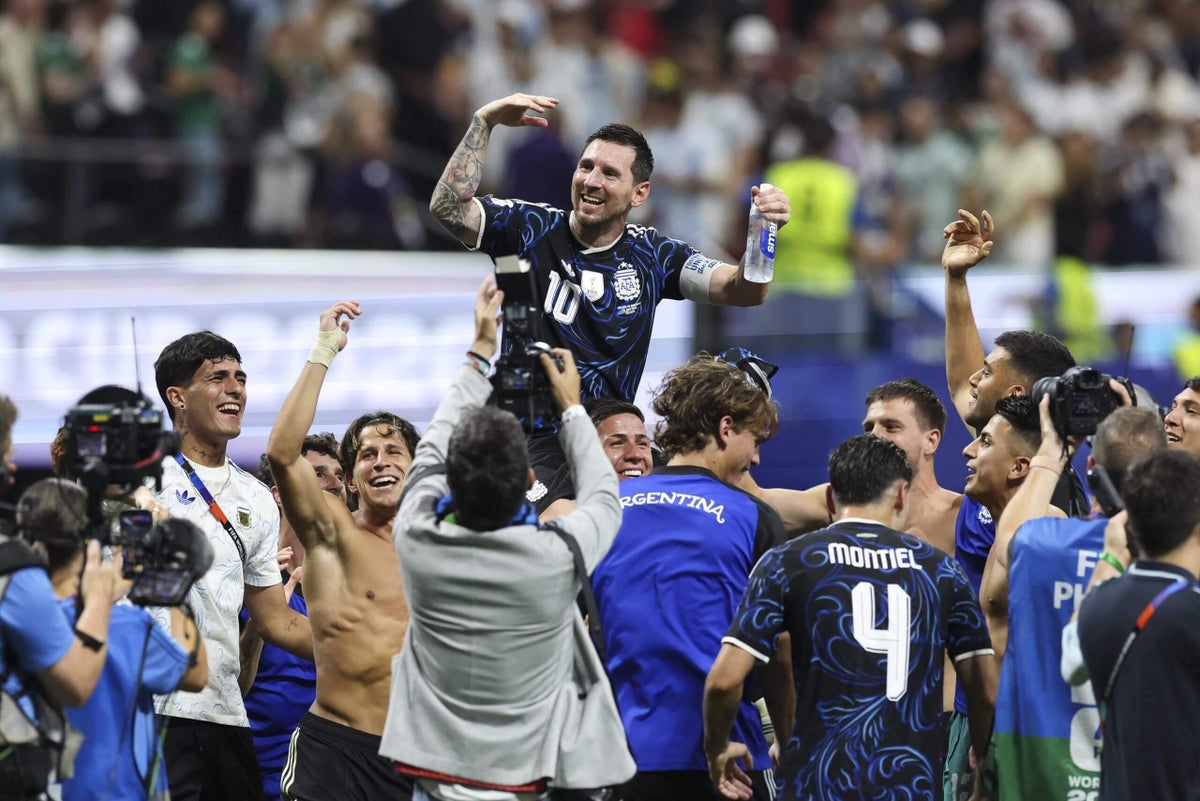
Lionel Messi and Argentina will play Spain in the World Cup final on Sunday after they scored twice in six minutes and 24 seconds at the end of a ferocious semi-final to break English hearts.
England had led from the 55th minute through Anthony Gordon and looked set for a first World Cup final since 1966, but as they dropped deeper and deeper, Enzo Fernandez curled in a stunning equaliser from outside the box on 85 minutes and then substitute Lautaro Martinez headed home in the second minute of stoppage time, with Messi assisting both goals. He now has 12 World Cup finals assists, a new record.
It was a game that began in fury and ended in chaos, with Argentina now having scored 11 times from the 75th minute onwards at this tournament.
These two teams had not played for 21 years, but the build-up to the match focused on the bitter conflicts of the past, including World Cup controversies and the 1982 Falklands War, which is referenced in songs sung by both Argentine players and fans.
Argentina made a physical start to the contest, and the first flashpoint came when England midfielder Elliot Anderson was hit from behind by Fernandez, with Jude Bellingham suggesting to U.S. referee Ismail Elfath that his team-mate had been struck in the back of the head with an arm.
No action was taken at that point, but the aggression continued with 12 fouls and no shots in the opening 30 minutes of the game — a record for a World Cup match according to Opta (whose records run to 1966) — before Anderson was booked for bringing down Messi, and Lisandro Martinez saw yellow for holding back Morgan Rogers.
The match opened up in the second half, with England taking the lead when Gordon steered in Rogers’ cross from the right on 55 minutes and then relying on a superb Djed Spence challenge and two very good Jordan Pickford saves to hold onto their lead.
But that resistance wouldn’t last; Argentina and Messi took greater and greater control, with Fernandez crashing in an equaliser and Lautaro completing an incredible comeback.
Argentina now play Spain in the World Cup final on Sunday, while England will meet France in the bronze medal match a day earlier.

Here, The Athletic’s Oliver Kay, Tim Spiers, Felipe Cardenas, Thom Harris, Anantaajith Raghuraman and refereeing expert Graham Scott break down the key moments.
Can Messi win another World Cup?
There was a moment, with seven minutes of the 90 remaining, when Lionel Messi, 39, found himself racing back towards the halfway line with Nico O’Reilly, 18 years his junior, to try to retrieve a loose ball. He got there first — just — but looked exhausted by the effort. Argentina were 1-0 down at that point and his pursuit of back-to-back World Cup titles seemed to be drifting to an unsatisfactory end.
He had made relatively little impact on the game. There were moments of skill and invention — there are always those moments — but England’s defenders had contained his threat.
And then, as against Egypt in the round of 16 at this same stadium in Atlanta last week, Messi took control. He didn’t score either goal, but he made them both, drawing defenders to him and picking out an unmarked Enzo Fernandez to score from distance for the equaliser and then producing a wonderful cross — with his right foot, no less — to pick out Lautaro for the winner.

Lionel Messi celebrates after setting up Argentina’s winner (Getty Images)
People used to say of Messi that he couldn’t deliver for Argentina when the pressure was on. What a joke that sounds like now. His quest for a second World Cup title will culminate in Sunday’s final against Spain.
At times, it seems written in the stars — but no, Messi writes his own scripts.
Oliver Kay
How did Argentina’s incredible comeback happen?
In the 31 minutes between Anthony Gordon’s opener and Enzo Fernandez’s sensational equaliser, England saw just 12 per cent of the ball. They took only nine touches in the attacking third, 165 fewer than their opponents.
Part of that was by design. Coach Thomas Tuchel had instructed his players to drop deep and soak up pressure in previous rounds against Mexico and Norway, and the introduction of centre-back Dan Burn from the bench was a signal of their intent.
But this pressure, against some of the finest attacking players in world football — and a team who just know how to get things done in this competition — was simply too much to bear.
Lionel Messi became increasingly influential as he was able to pick up the ball outside the penalty area with England bunkered in, floating in several dangerous balls into the box. But it wasn’t just him, as Rodrigo De Paul swung in a curling cross for Alexis Mac Allister to send a warning clanging off the post.


Fernandez’s effort from outside the box was equally well-struck, whipped into the far corner out of Jordan Pickford’s reach, while it was a moment of magic from Messi — standing up a brilliant ball to the back post with his weaker right foot — that meant Lautaro could hardly miss.


Lautaro Martinez heads in Messi’s cross for the winner (MB Media/Getty Images)
That was Argentina’s 11th goal after the 75th minute already in this tournament, a testament to their inevitability, as they reach a second consecutive final and third in the past four World Cups.
Thom Harris
What did Argentina get right?
Argentina were not the disorganised and lacklustre team we had seen throughout the knockout stage. Lionel Scaloni’s side were disciplined against England and relatively clean on the ball. Their attack came to life after Anthony Gordon’s 55th-minute goal as England chose to sit back and allow them to take hold of the match.
When Enzo Fernandez’s long-distance strike sailed past Jordan Pickford for the equaliser, the shift in momentum was fully established.
Lionel Messi, who had been relatively contained, understood that England had essentially given up on trying to play. Messi found the ball where he is most effective: near the opponent’s penalty area. He got his touches, and his team-mates buzzed around him.
Alexis Mac Allister hit the post, which sent a warning to Thomas Tuchel’s side. Then, Messi received the ball in a wide channel, took on his defender and sent a perfect cross with his right foot that Lautaro Martinez headed home. The comeback was complete.
The Argentina fans rejoiced as if they knew the inevitable would happen. Argentina had done it again. Having looked like a team on their last legs, they will play for a second consecutive world title on Sunday.
Felipe Cárdenas
What did England get wrong?
England have endured devastating World Cup semi-final heartache in years gone by, but this one perhaps felt even worse than ever.
In 1990, they lost to West Germany on penalties in crushing circumstances, but had chased the game for the most part and grabbed a late equaliser in a match they were underdogs for. In 2018, they led for much of the game against Croatia before being pegged back from the 68th minute onwards in a tournament they were never expected to win.
Here? To be 1-0 up in the 85th minute and having looked like the more competent side, well, to lose in regulation time was almost beyond words.

Tuchel’s team got deeper and deeper (Getty Images)
The game was England’s. They had overcome Argentina’s brutal physical approach, they were in the lead, and they looked defensively sturdy. The world champions looked pretty ordinary.
For England to retreat into a deep 5-4-1 shape after the second-half hydration break, inviting Argentina to attack, which they did relentlessly, saw the tide of the match completely turn in the opponents’ favour.
Attention in the fallout will undoubtedly focus on Thomas Tuchel’s uber-defensive approach, rather than any individual mistakes England players made. There is always a scapegoat in these situations — be it someone who misses a penalty or someone who is sent off.
On this occasion, it’s squarely on Tuchel.
Tim Spiers
How furious was this game?
We expected flashpoints, we expected argy-bargy — and this game did not disappoint.
The tone was set before kick-off. In fact, for some people, the tone was clearly set in 1982 in the Falkland Islands, but in Atlanta on Wednesday at least, both national anthems, particularly God Save the King, were completely silenced by a cacophony of jeering and heckling.
Within seconds of kick-off, that animosity transferred to the pitch with Jude Bellingham shunted through the back by Leandro Paredes. The Englishman grinned it off.
Then, within two minutes, Enzo Fernandez left a forceful arm on the back of Elliot Anderson’s head. The new Manchester City midfielder got his revenge eight minutes later with a late foul. Payback.

Fernandez strikes Anderson (Eddie Keogh – The FA/The FA via Getty Images)
This continued for the entire ‘first quarter’ of the match, with no shots and 11 fouls before the hydration break. Both teams incessantly fouled, kicked and barged each other, stopping the game from flowing and preventing the opposition from launching counter-attacks.

Lisandro Martinez pulls Bellingham’s shirt (Getty Images)
At one point, Lionel Messi attempted a dart from midfield and it took five challenges from England players to stop him, with Anderson eventually managing it and earning a booking. Bellingham in particular relished the brutality of the occasion.

Messi is sandwiched (Martin Rickett/PA Images via Getty Images)
Tim Spiers
How well did the referee cope?
This was as tough a game to referee as they come, and Ismail Elfath did all he could to keep control of everyone on the pitch, including himself.
Referees’ principal aim in the opening stages of such high-pressure matches is to keep the temperature at a manageable level. By the first hydration break, the free-kick count was already in double figures, but Elfath had kept his yellow card in his pocket.
The received wisdom is that this is the best approach, because if you go too early and set the threshold too low, problems can mount. Of course, this comes with the risk that the players get frustrated and start taking matters into their own hands.

Elfath waves his yellow card (Tom Weller/picture alliance via Getty Images)
A yellow card apiece for each side followed, with the first being waved around indiscriminately before eventually being shown to Elliot Anderson.
Poor carding technique aside, the general approach worked for Elfath, as evidenced by a second half in which he went about his work largely unnoticed.
He becomes the first referee to come through this fixture at a World Cup unscathed, with neither side being able to claim that a decision cost them the match.
Refereeing expert Graham Scott
How did England take the lead?
This semi-final was desperate for a goal, and after 55 minutes of attritional football, the breakthrough finally came.
Space was at a premium throughout, but a precious pocket opened up as Harry Kane drifted into his own half to offer an out-ball for Reece James. It wasn’t the first time England’s No 9 dropped deep to drive the ball out to the flanks, and though his pass was ultimately intercepted by Lisandro Martinez, it helped to set England players free further up the pitch.


Declan Rice had galloped forward in anticipation of a knockdown and was rewarded for that optimism as he played a neat first-time pass out to Morgan Rogers.
Rogers had plenty of time to pick out a runner, and he delivered a teasing ball to the back post, where Anthony Gordon did well to hook his right foot around the bouncing ball.
Argentina’s right-back Nahuel Molina glanced over his shoulder and was clearly aware of Gordon’s run, but was caught flat-footed as Rogers shaped up to cross.


That was his first World Cup goal, just as it was for the new Barcelona signing’s former Newcastle United team-mate Kieran Trippier when he opened the scoring in the semi-final against Croatia eight years ago.
Thom Harris
Was this the tackle of the tournament?
It was a challenge that at first did not seem possible.
Having gone behind moments earlier, Argentina won the ball in their own third and a quick exchange between Enzo Fernandez and Lionel Messi allowed the former to find Giuliano Simeone running in behind. The Atletico Madrid forward was in prime position to benefit, bearing down on goal as Jordan Pickford braced for the inevitable.


Then came Djed Spence, a freight train bustling forward out of nowhere. His slide was timed to perfection and he took the ball off Simeone’s toes just as Argentine eyebrows raised in anticipation.


Simeone is stopped by Spence (Image Photo Agency/Getty Images)

Spence celebrates his challenge (Patrick Smith – FIFA/FIFA via Getty Images)
Spence’s celebration — a roar towards the crowd — followed by chest- and fist-bumps from his team-mates was indicative of the magnitude of the moment. Given the occasion and execution, that was the tackle of the tournament, one that fans of England and Argentina will not forget in a hurry.
By the end, though, Argentina had found a way through. Twice.
Anantaajith Raghuraman