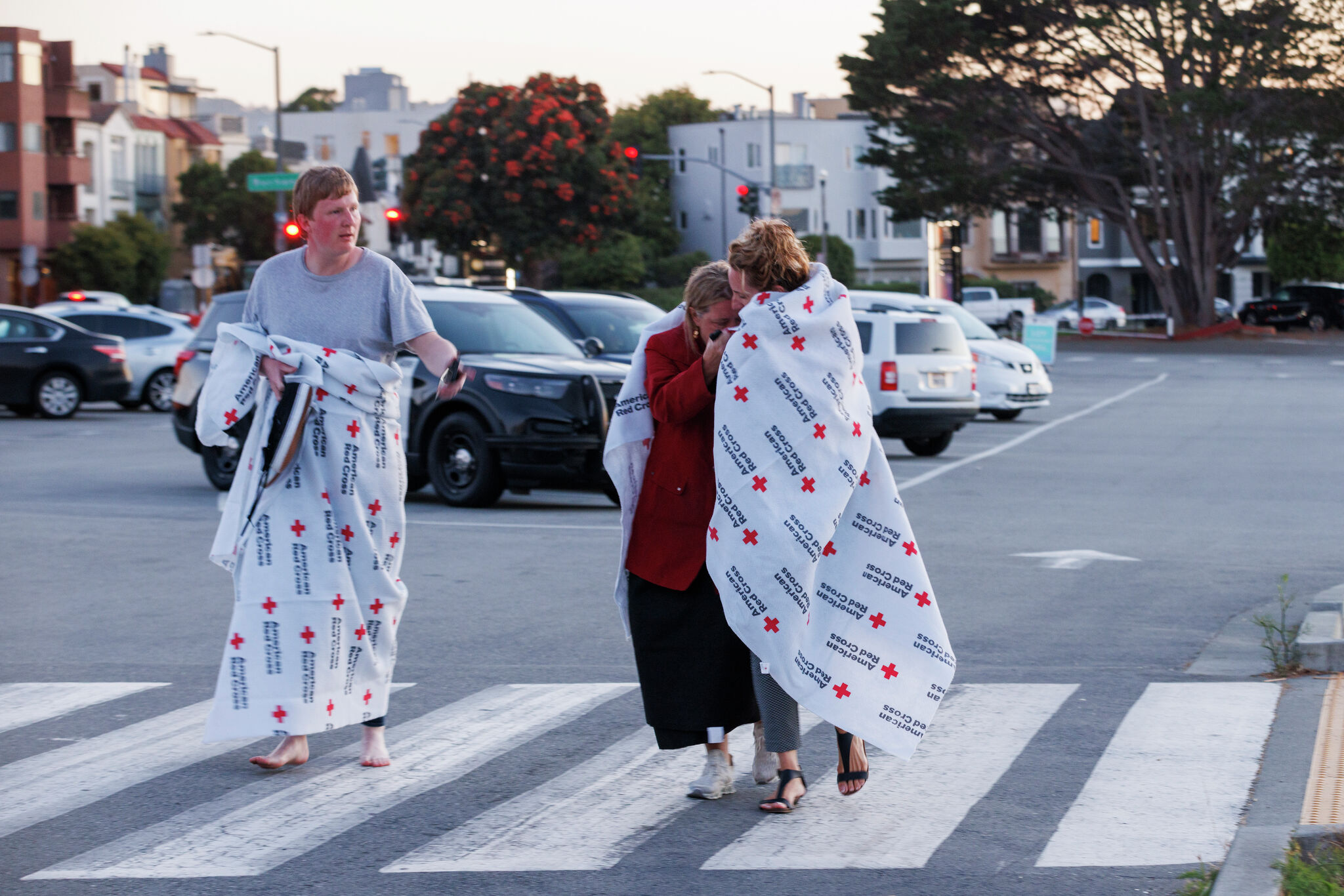

People cover themselves with Red Cross blankets at a Fort Mason assistance center for survivors impacted by the deadly boat incident Tuesday.

Three generations of the Boisa family set out from a San Francisco marina aboard the Volare, seeking to honor a woman who loved the bay.
On the 49-foot cabin cruiser Tuesday, 20 aunts, uncles, cousins, siblings and friends prepared to scatter the ashes of Maria Boisa, a nurse from Fremont who died by suicide at age 32 in 2015. They enjoyed a breezy and balmy morning, passing under the Golden Gate Bridge before stopping for the afternoon at Angel Island.
Article continues below this ad
By 3:30 p.m., the three-deck vessel was on its way back to the San Francisco Marina Yacht Harbor, where John Boisa, the boat’s captain and a former naval officer, had reserved a berth.
Having left the protection of the Marin Headlands, they crossed one of the deepest sections of the bay, 1½ miles from the nearest shore at Alcatraz. Most passengers stood on the deck outside, while others sat in the wood-paneled cabin.
The sky was still clear, but winds were picking up. Tides were pulling in the opposite direction, whipping water into whitecaps. A weather station at Fort Point, about 2½ miles west of the Volare, measured 20 to 22 mph winds and gusts up to 30 mph.

James Kim, 37, said he witnessed and photographed the cabin cruiser sinking and rescue efforts from about 3:30 to 4 p.m. Tuesday.
Suddenly, a big wave crashed into the Volare, causing it to pitch to the side. Two passengers seated in the cabin were thrown onto their backs, and another was struck in the head by an unknown object. The boat was sinking.
Article continues below this ad
“They were trying to get out, banging on the windows,” said 77-year-old Ralph Boisa, whose daughter, Yvonne Thatcher, was among those inside and recounted the events to her father. “My daughter managed to get to the door and get it open, and she got out.
“The other three,” he said, “did not.”
Members of the Boisa family had come from all over Northern California for the occasion, converging from Stockton, Auburn (Placer County) and the Sacramento suburbs. By Wednesday night, John and Ralph’s older brother, 79-year-old Clifford Boisa of Sutter County, was dead — and the search for three missing passengers was called off. On Thursday, a second body was recovered — that of Tondra Madruga, 58, of Sacramento County.
John Boisa, 62, of Stockton was the youngest of four siblings. He and his wife Miriam Lyell, 63, owned the boat. With them on the voyage were Clifford Boisa and his wife, Jackie Boisa; their sister, Carol Boisa, 74; and two other generations of family members.

People walk out of Fort Mason, where the Red Cross set up an assistance center for people impacted by the deadly boat incident Tuesday. One person was reported dead, three remain missing and several people were reportedly injured after a boat carrying 20 people capsized in the bay between Alcatraz Island and the Golden Gate Bridge.
People close to John Boisa described him as an experienced captain. He’d served four years in the Navy, according to social media profiles and public records. A former social worker and political consultant, he is part of a group that advocates for state policy on behalf of boaters.
Article continues below this ad
His wife was the first female public defender for San Joaquin County. Clifford Boisa had worked as a reserve deputy for the Sutter County Sheriff’s Office. Clifford and Jackie were visiting from Rio Oso, north of Sacramento; Carol came from Citrus Heights.
John invited the family on his boat about once a year to venture out under the Golden Gate Bridge, Ralph Boisa said. It was a 1980s trawler with a fully fitted wooden interior, a bathroom and a General Electric refrigerator painted with the words “love” and “faith,” according to videos posted online in 2017. On social media, John described spending nights sleeping in one of three below-deck cabins.
This time, they’d gathered to remember Maria.
“She was a big surfer, loved the water, loved the bay, and that’s why they put her ashes out there,” said Ralph, who adopted Maria and eight other children.
He and his wife, living in Washington state near the Canadian border, had stayed home. But his daughter Yvonne Thatcher and her family had come from Auburn to remember her sister.
Article continues below this ad
From the vantage of the middle deck, where Yvonne settled for the journey amid her aunts and uncles, the impact came without warning.
“They didn’t see or hear anything,” Ralph said, describing his daughter’s account. “They’re sitting, and all of a sudden, the boat went over.”
The sudden jolt tossed people into the water. Some were wearing life jackets, first responders would later say; others were not.
Steam rose from the boat, confusing onlookers who reported that the vessel was on fire. Passengers clung to the disabled Volare and debris floated in the water while those trapped inside banged on the windows of the cabin.
As the Volare foundered, several nearby boaters and other onlookers reported the boat in distress and rushed to help. The Coast Guard signaled “mayday” over the radio.
Article continues below this ad

A San Francisco Police Department boat patrols the bay as authorities search for three missing passengers from the Volare, a 49-foot cabin cruiser carrying 20 passengers that capsized in rough seas Tuesday near Alcatraz Island in San Francisco.
A kiteboarder was one of the first to arrive. Four or five of the passengers survived by clinging to his board.
Near Fort Mason, people on a small boat who had noticed the Volare sinking flagged down the Bass-Tub, a 56-foot fishing vessel. Aaron Anfinson, the Bass-Tub’s captain, was carrying 32 passengers on a pleasure cruise, but raced into the bay to help.
By the time the Bass-Tub reached the Volare, the vessel was in serious trouble. Anfinson said people on his boat started to hand flotation devices to passengers on the sinking craft. His deckhand lowered a swim ladder and threw a life ring to a woman who had injured her head. Rescuers also recovered a dog that had died.
“It was scary,” Anfinson said. “I don’t want to see anybody in that situation.”
First responders from across the Bay Area arrived almost immediately: police boats from San Francisco and Richmond, firefighters from Marin County and officers from Oakland who had been completing a training operation nearby, among others. Videos showed rescuers battling choppy waves as they pulled people from the water.
One rescued man was “in severe distress.” It was Clifford Boisa, nearing his 80th birthday.
San Francisco police marine unit officers tried to resuscitate him as they rushed him back to Gashouse Cove Marina, a fueling station next to Fort Mason.
Standing near the shoreline, Christine Kaplan saw the police boat come speeding into the cove and heard sirens wailing. She knew there was “some sort of trouble.”
“We’ve got somebody on board,” the rescuers called out, then tied up the boat.

Two people embrace in the doorway of a reunification center at Fort Mason on Tuesday in San Francisco. One person died and three remained missing.
Soon, other teams brought 17 people from the Volare to the dock. Cold, shivering and wet, some had leg and head injuries. Firefighters guided three wounded boaters — including John Boisa — to waiting ambulances and others to a Fort Mason warehouse where emergency workers brought them chairs, blankets and dry clothes.
Despite their efforts, Clifford was pronounced dead at the dock. He is the only passenger officials have identified or confirmed to be deceased.
Kaplan said one distraught woman cried out that her mother was missing, repeating it over and over.
For the next 29 hours, rescue crews searched more than 950 square nautical miles for the missing passengers, authorities said. Across the airwaves, the Coast Guard played a message on a loop, warning boaters of the search.
“The Coast Guard has received a report of a capsized vessel,” the alert blared. “With zero three persons in the water unaccounted for.”

Emergency responders shelter a deceased victim from view as they transport the body from Gashouse Cove to a van at Fort Mason after a boat carrying 20 people capsized and sank in the San Francisco Bay on Tuesday.
After the recovery of family friend Tondra Madruga’s body Thursday, two people were still missing: Ralph’s sister Carol Boisa and sister-in-law Jackie Boisa, Ralph Boisa said.
Among the other survivors were Yvonne Thatcher, her husband and their three adult sons.
The Coast Guard will investigate the sinking, which U.S. Coast Guard Capt. Jarod Toczko said occurred after a large wave left the Volare unstable and “listing heavily,” causing it to quickly roll over. But Toczko cautioned that investigators had not determined why the vessel lost stability or what ultimately caused it to sink.
“All indications are that things happened very quickly,” he said. “When the vessel took on a wave over the side, it quickly rolled to starboard.”
The Coast Guard said the boat was capable of handling 20 people. The trawler was up to date with its Coast Guard certificate of documentation, which was last issued in 2025 and would expire in 2030.
John Boisa had piloted his vessel down to San Diego just last year, his brother said.
“He was very competent in his ability to handle a boat,” Ralph Boisa said. “That’s why I’m so shocked at what happened. I don’t understand it.”
Toczko said it was “highly likely” the missing three passengers were trapped inside the boat as it sank to the bay floor at least 120 feet below.

John Boisa returns home Wednesday in Stockton. Boisa is confirmed to be the captain of the Volare, which capsized Tuesday near Alcatraz.
The vessel lies somewhere on the bottom of a deep channel, usually traversed by container ships bound for the Port of Oakland, although authorities don’t know its exact location. It sank too far down for local fire divers to attempt to reach it, and Coast Guard officials said they will have to try to locate it with an underwater drone.
Only then will they be able to determine whether they can salvage the boat.
Nineteen hours after the Volare sank, John Boisa, his wife, son and another woman pulled into the driveway of their suburban Stockton home.
John Boisa and his family members wore gray sweatshirts and sweatpants. He was not wearing shoes, just yellow socks.
Speaking softly, he asked a reporter for privacy and declined to answer questions.
“All of us are grieving during this time,” he said.
Sarah Ravani, Chrissa Olson and Kathryn Palmer contributed to this report.