
Photo: Apple TV/Copyrighted
When Widow’s Bay debuted back in April, it was clear right away that this was a rare thing in the current television landscape: an exceptional, original series that had a clear sense of its own identity right out of the gate. Katie Dippold’s streaming sleeper hit has been so consistently great at its delicate cross-tonal dance — it excels at comedy, horror, drama, even overhead projector storytelling, a form that’s really blowing up these days — that it seemed like the finale would have to be a disappointment on some level. A show can’t be this consistently, delightfully fantastic in its first season.
Well, guess what, friends? Sometimes the universe actually does let us have nice things. “We Hope You Enjoyed Your Time!”, the 49-minute season one finale of Widow’s Bay, delivers everything one could have reasonably hoped for from the conclusion of this corker of an Apple TV show. It also confirms that Widow’s Bay is the best new series of 2026 and perhaps even the best series of the year, period. I’m not saying that there definitely won’t be a better comedy or drama in the months ahead. What I am saying is: good fucking luck, other shows. You’ve got some serious mukluks to fill.
“We Hope You Enjoyed Your Time!” makes sure to answer some significant questions about the island, starting with a big one: whether Ruth Livingston, a woman who knows her way around an herbal tea, is the last living descendant of Richard Warren. It turns out she is not because — Bombshell No. 1! — Ruth had a daughter with a man she was having an affair with and gave up the little girl for adoption. And that little girl turns out to have been — Bombshell No. 2! — Lauren, Tom’s late wife. Which means that — Bombshell No. 2b! — Evan is actually the last living descendant of Richard Warren. In my most Keanu Reeves voice, all I can say is: “Whoa.”
Given Tom’s immediate instinct to cover up Evan’s status when Bechir asks who is the island’s true heir, it seems likely that maintaining that secret will be a running thread in season two. (Yes, there will be a season two. Hooray!)
What Widow’s Bay pulls off in this episode is audacious and, again, so deft at being audacious that you don’t even appreciate right away how audacious it is. In addition to the business about the Warren bloodline, it confirms that the island does indeed require blood sacrifices; it delivers a beautifully acted cross-generational conversation between Tom and Ruth that forms the core of this episode and, in many ways, the series; and it manages to make allusions to Mary Shelley’s Frankenstein, Lost, the words of Tennessee Williams, and South Park. Because who gets sacrificed, albeit inadvertently, near the end of the episode, seemingly making the deadly storm abruptly stop as if God herself had pulled the plug on it? The poor Town Hall employee who shoos Evan and his friends out of the creepy underground room with the creepy chair. And what is that Town Hall employee’s name? Kenny. That’s right: Widow’s Bay killed Kenny. Those bastards!
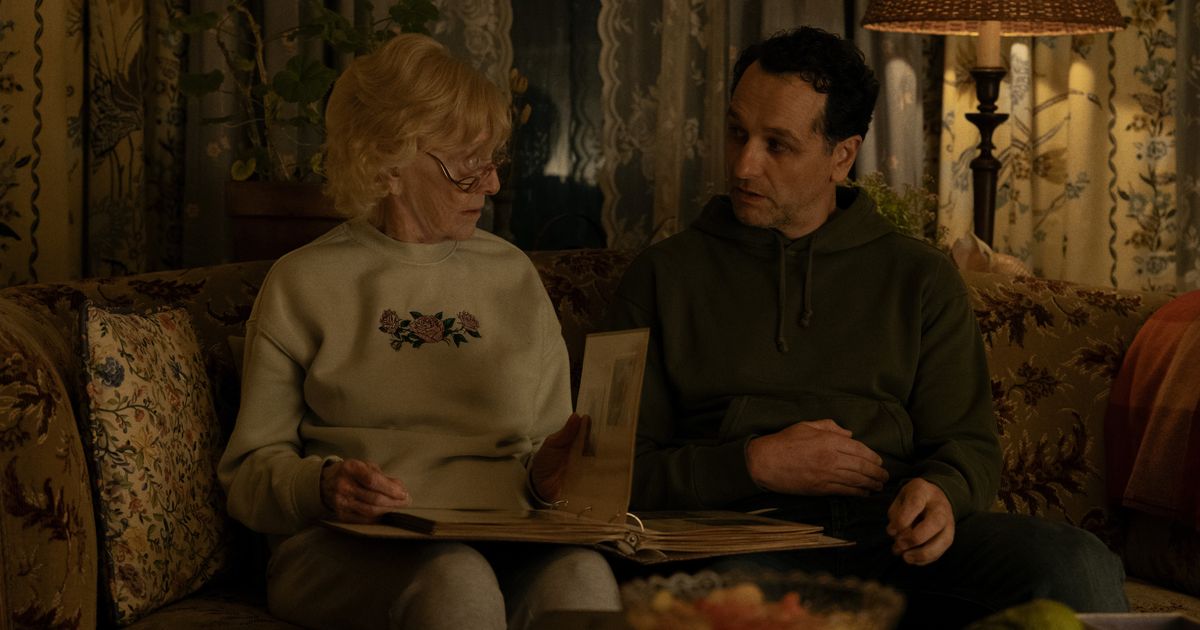
I fear there will not be adequate space in this recap to mention all the incredibly funny moments in this episode, and particularly in the Tom/Ruth sequence, which is a riot and poignant and beautiful all at once. K Callan, a 90-year-old legendary actress, gives such a rich performance here as Ruth, who is simultaneously a bundle of energy and a slightly dotty old woman whose stories tend to leave out significant details. Of an old boyfriend that she says she loved very much, she notes, “He got bit by an animal and became that animal.” She never explains further. Which is a shame because I have many follow-up questions.
Her response to Tom when he asks her about the Trolley Problem is equally hilarious: “You mean back in ‘42 when we tried to build one and all the workers disappeared?” Tom then explains the actual Trolley Problem, the philosophical debate about having to choose whether to pull a lever that will prevent a runaway trolley from killing multiple people, but will still result in the death of a single person. Ruth instantly knows what she would do.
“You can’t control the bad things that happen in life, Tom,” she says. “But if I pull that lever, it’s a choice. I’m choosing to kill that person and I could never do that.” Ruth is basically saying that matters of life and death should be left up to fate, or God, or who/whatever you think controls the world in which we live. But she is also saying something more nuanced and profound than that.
Ruth then reads from a Tennessee Williams quote that she turned into a cross stitch, even though Williams’ comment is too long to properly fit on a cross stitch. It says: “The world is violent and mercurial — it will have its way with you. We are saved only by love — love for each other and for the art that we feel compelled to share: being a parent; being a writer; being a painter; being a friend. We live in a perpetually burning building, and what we must save from it, all the time, is love.”
“We live in a perpetually burning building, and what we must save from it, all the time, is love.” If this doesn’t summarize what it feels like to be alive in 2026, my God, I don’t know what does. But it also feels like a declaration of what Widow’s Bay wants us to take away from this gem of a weirdo TV show: that the way we care for one another, in all its multi-faceted imperfection, is the point of being alive and the greatest gift we offer to our fellow humans.
At the same time, that quote and Ruth’s attitude also implies that nothing can be done to extinguish the fire in the perpetually burning building. She says as much after reading that cross stitch quote to Tom. “You want this to be Martha’s Vineyard. It’s never going to be,” Ruth says of Widow’s Bay. Then she gets, in the words of Cher Horowitz, way existential.
“There’s no bliss waiting at the finish line,” Ruth continues. “Even if there was, it would just be taken away from you because that’s just life, in all its ugly, beautiful, terrible glory. You just have to accept it.”
If I know Mayor Tom Loftis — and after 10 episodes, I think I do — he does not, cannot, and will not subscribe to that point of view. He will try to save his son, and rescue the island, for as long as he’s able to inhale and exhale. I believe this because at the end of this episode, he launches the broach that Sarah Warren passed down through generations of Warrens, until it eventually landed in Ruth’s hands, into the sea as if he’s trying to cast off the albatross that is the history of this godforsaken island. He and Evan drive off, perhaps to head home or perhaps to try to make it to that Red Sox game Tom bought tickets for the two of them to experience. (How upsetting is it, by the way, when Tom realizes he can never take Evan off the island after promising his son he could? Matthew Rhys, you are a treasure and don’t you ever forget it.)
Either way: the finale has set up a potential argument between fate and free will. Which reminds me of another show that loved to foster debate about fate vs. free will more than my philosophy professor in college who literally made us argue about this in every class for an entire semester. That’s right, I’m talking about Lost! Look, if you watched Lost at all and were somehow still not reminded of the Dharma Initiative orientation videos when Dale sat down and watched those freaky filmstrips marked “For Them” and “For You,” I truly don’t know what to say. I have no idea how to watch those scenes without being reminded of Lost.
“So you’re an offering,” says the nice man in the film labeled “For Them.” “You’ve been carefully selected by a committee of your peers in a very fair, very rigorous selection process. Maybe you’ve committed a crime. Or owe a debt to society. Or have been found wanting in some way. Although you’ll never know, take comfort in the fact that there is an absolutely unassailable reason you are here.” This is the justification for killing people, which, by the way, does not sound that different from the justifications governments offer for violating people’s human rights. And yes, when I say “governments,” I am certainly including the current one in these United States.
Then there’s the “For You” film, directed at those who don’t need to make such sacrifices because they have not been found wanting: “The bad times will not end until the covenant is honored, and honored fully. Life for life. The island will make its needs known.” The footage shows men and women with bags over their heads, chained to the wall in the underground tunnels, looking not that dissimilar from detainees at Abu Ghraib. “One soul for each bell toll,” the narrator says. “You will be tempted to comfort them. Do not. Their fear is necessary. They say it likes the taste. Now, let’s pray for a long and peaceful slumber.”
Okay: What does “it likes the taste” mean? Is “it” the island? And is that why, when Evan enters the room where the electric chair is located, the word “it” appears to be etched on the door? Or is “it” a spirit that lords over the island? Or is “it” just a reference to Stephen King? Whatever “it” means, the impact is alarming, as reflected by the cut to the expression on Dale’s face after watching this — Jeff Hiller’s mouth is fully, fully agape —and his subsequent response to what he just witnessed.
“This place is a death trap! Run! Run for your lives!” he screams, causing a panic in the emergency shelter. The situation is definitely not helped by the dude who just cranked up the volume on an automated announcement in the shelter that states, “It’s time. Listen to your facilitator. Move forward. Do not beg.”
By the end of the finale, we still don’t have a full grasp on what happens in the aftermath of the storm. It’s fair to assume that everyone in the emergency shelter made it out unscathed once the storm stopped. But we don’t know what’s going on with Chelle, Bechir’s wife who seems poised to deliver a baby even though she’s seven weeks ahead of her due date. (What if so many people die on this island because its one medical professional, Dr. Morgan, is so condescending that he misses important details and diagnoses. “I’m sorry. I didn’t realize you went to medical school,” is this guy’s catchphrase.)
Did Chelle have the baby? We don’t know. Did Ruth survive the out-of-nowhere, gasp-inducing bullet wound inflicted on her by an irrational Bechir, who believed killing her could extinguish the curse on the island and, potentially, his soon-to-be-born child? I believe she did. I believe this partly because she seems to be alive after being struck by the bullet and, importantly, after the storm has stopped and Kenny is no more.
I also believe that, like Richard Warren and the Boogeyman before her, Ruth may be immortal, at least as long as she stays on the island. Ruth has a largely impeccable physical from her doctors, as Tom discovers. She is in her 80s and can walk on a treadmill, then bound up a flight of stairs, which many people at that age cannot do, unless they’re Bruce Springsteen. As Tom notices when he looks at her calendar, she is incredibly active and busy. After drinking the tea with the diazepam in it, she still wakes up, groggy but unbothered. I can’t say for certain that Ruth is unkillable. But I’m pretty sure.
What I do know is that the island is not done demanding sacrifices. Right before Tom gets back in the car after tossing that brooch like the heart of the ocean necklace from Titanic, the church bells ring. Eight times. Which means the island craves eight more souls, one for each bell toll.
This is not good for the people of Widow’s Bay. But for the people who watch Widow’s Bay, this is excellent. It means there are more mysteries left to solve, and freaky, hilarious moments to witness and more of the ugly, beautiful, terrible glory that is this magnificent TV show. See you in season two.
• In last week’s recap, I wondered whether Patricia might be a descendant of Richard Warren given her concerns about identifying who his last living relative might be. But now I think she somehow knew that Ruth was Lauren’s mother and that Evan is a descendant. She didn’t want that information to come out because she was trying to protect Tom. I don’t know how she learned all of this — maybe she figured it out during her brief possession in episode four? — but that’s my theory at this point.
• When Tom asks Ruth about her story club, she explains that she and her friends gather and literally write stories together, noting that this is how Mary Shelley wrote Frankenstein. Which is true: while trapped inside during a storm, she and a group that included her husband, Percy Bysshe Shelley, and Lord Byron, passed the time by writing stories together. Shelley’s famous Gothic horror novel was born out of those sessions. Mary Shelley also seems like the type of person who would fit right into the Widow’s Bay community. Her mother died shortly after Mary was born; her husband eventually died in a sailing accident; and she gave birth to five children, only one of whom lived to become an adult. (Cue the sound of Rosemary going, “Dead baby, dead baby, dead baby.”)
• Tom also takes notice of the item on Ruth’s calendar that says “Help Deidre down, help Deidre up,” a reminder to help her neighbor get on and off her porch every day. This may be a complete coincidence but the novelization of 1978’s Halloween, a frequent reference on Widow’s Bay, contains a whole backstory about how the curse of Samhain began on Halloween in Ireland years ago, when a disfigured boy murdered the daughter of a king, who he’s in love with, and her fiancé. The name of that daughter: Deirdre.
• While going through old photos, Ruth repeatedly points to men who made a pass at her, yet another sly acknowledge of what a den of misogyny Widow’s Bay is. Then she gets to a picture of Pastor Roberts. “He was like a father to me,” she says. Tom says he hopes that the clergyman didn’t make a pass. She laughs it off, then goes: “Oh you know what, you’re right. He did make a pass.” This is hilarious and, also, a reference to the same pastor whose letter is briefly seen in episode seven. “I wish my words alone would convey the gravity, but this is the only way you will understand,” is the only portion of the note that remains, but it suggests Pastor Robert may have killed himself much like Bryce did.
• Best Visual Gag of the Week: No contest, it’s when all the lights go out in the shelter and, in an effort to calm everyone, Patricia turns on her flashlight. Unfortunately, she points it directly under her chin, the way people do when they’re trying to scare the shit out of everyone sitting around a campfire, prompting gasps from the already frightened group. Never change, Patricia. Just don’t do it.
• Funniest Line in the Finale: This is difficult because so many things made me cackle. Ruth definitely has the best lines of any character in this episode purely based on volume. The Trolley Problem one, mentioned above, is amazing. So is: “Oh, that was the summer my Aunt Betty stopped speaking. First we thought she was pouting, then it turned out it was something else.” What was the something else, Ruth??
But I have to turn to the queen of overhead projection, Rosemary, who wins because she gets a two-parter: a really funny line leads to a callback that is even funnier. Early in the finale, Rosemary points out in her matter-of-fact way that, “The gal who had my job before me, she told me to never go into this shelter.” Wyck asks, “And why would that be?” Rosemary: “She never said.” Many scenes later, right after the PA system in the shelter suddenly blares the announcement that says, “Move forward. Do not beg,” Rosemary drily notes, “That’s probably what she meant.” I laughed so loud I am pretty sure they could hear me in Martha’s Vineyard, a place that may be very nice but I am sure is not nearly as darkly amusing as Widow’s Bay.