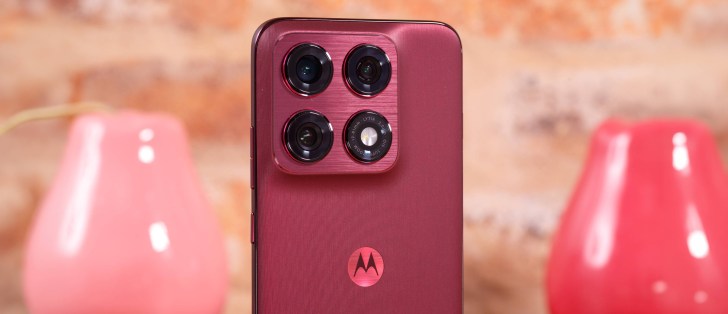
A nicer sensor on the telephoto completes a quad 50MP setup
The Motorola Edge 70 Pro brings an improvement to the camera system – a new telephoto module for more detail and extended reach. The main camera may or may not have gotten a sensor tweak too. Ultimately, you’d be getting three 50MP rear cameras and another 50MP unit on the front.
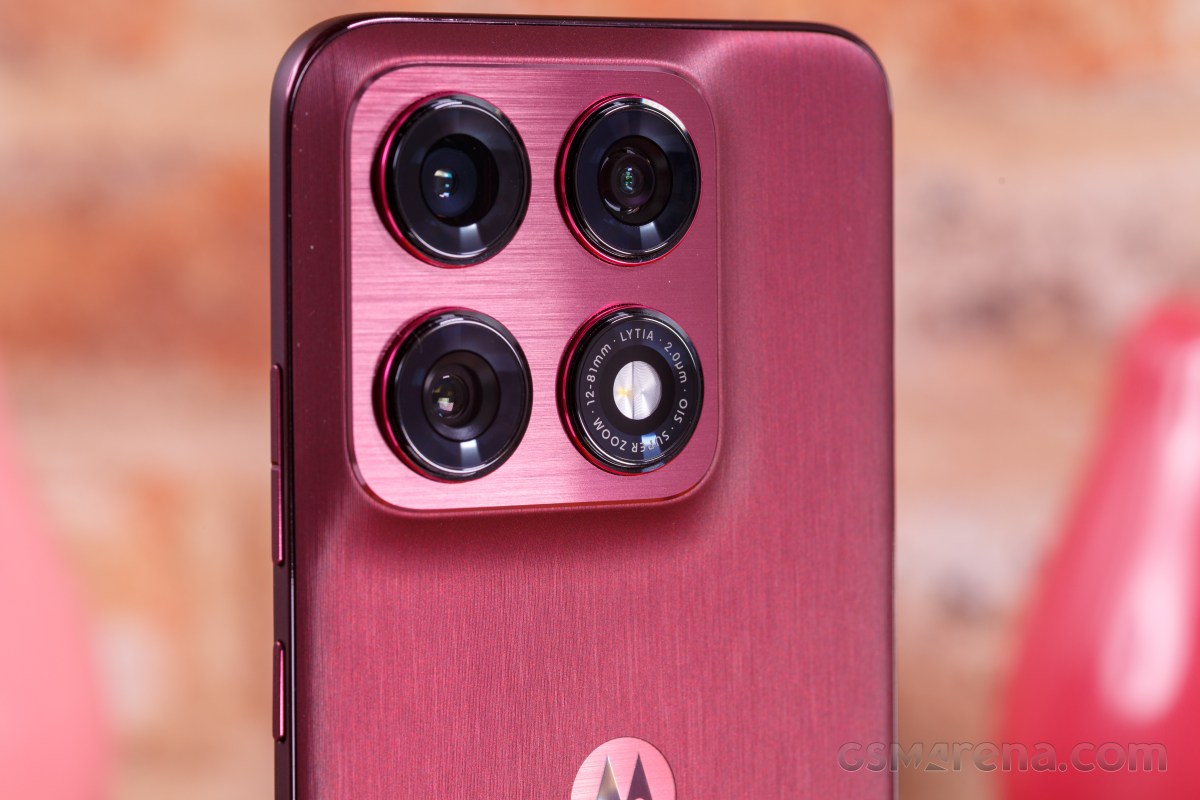
On the telephoto, you’d be getting the Samsung JN5 sensor, a familiar sight on secondary cameras of all market tiers. It’s replacing the fairly basic 10MP unit of the Edge 60 Pro, so the improvement is in both resolution and sensor size (1/2.76″ vs. 1/3.94″ optical format). The lens has an 81mm equivalent focal length, which is a minor upgrade over the 73mm of the previous model, but the new sensor should allow for some reasonable quality results when zooming in at twice the telephoto’s nominal focal length.
The main camera lists a Sony IMX 917 imager in hardware apps, which Motorola’s spec sheets refer to as Lytia 710. It’s a 1/1.56″ sensor, the same size as that on the previous model, which had the Lytia 700C. Sony’s documentation says that the 710 has “Improved sensitivity by 3% and SNR10 by up to 10% compared to LYTIA 700C due to upper layer modifications”. Alright, if they say so.
The ultrawide is shared across all the recent higher-tier Motos (Signature, Razr Fold, Razr 70 Ultra) and uses a Samsung JNS sensor paired with a very wide 12mm-equivalent lens with AF.
Selfies are also taken care of by that same imager on the Edge 70 Pro, only with a different lens – a 22mm focal length is a lot better suited to this particular role, and it’s still nicely wide. That camera is the same as on the previous model, and if you like splitting hairs, it’s, in a way, better than that of the flagship Signature’s kit – slightly larger sensor (1/2.76″ vs. 1/2.93″), slightly brighter lens (f/1.9 vs. f/2.0).
- Wide (main): 50MP Sony Lytia 710 (IMX 917, 1/1.56″, 1.0µm-2.0µm); 24mm, f/1.8, OIS, multi-directional PDAF (9.5cm – ∞); 4K60 video recording.
- Telephoto: 50MP Samsung ISOCELL JN5 (S5KJN5, 1/2.76″, 0.64µm-1.28µm); 81mm (3.5x zoom), f/2.8, OIS, multi-directional PDAF (34cm – ∞); 4K60.
- Ultrawide: 50MP Samsung ISOCELL JNS (S5KJNS, 1/2.76″, 0.64µm-1.28µm); 12mm, f/2.0, PDAF; 4K60.
- Front camera: 50MP Samsung ISOCELL JNS (S5KJNS, 1/2.76″, 0.64µm-1.28µm); 22mm, f/1.9, PDAF; 4K60.

Daylight photo quality
Main camera
The Edge 70 Pro’s main camera photos are great. They have excellent detail that’s rendered in a reasonably non-artificial way, with no noise in there to speak of. Dynamic range is wide, but there’s also plenty of contrast. Add to that the lush greens and otherwise vibrant colors and you’d be looking at quite punchy outdoor shots. Our indoor scenes turned out a little less enthusiastic, but by no means dull. It’s hard to find something to dislike about these photos.








Daylight samples, main camera (1x)
Photos of people are plenty nice as well, though if you’re shooting your subjects in nature, those vivid greens may be overpowering, plus skin tones might end up a little off in bright sunlight. The bokeh effect in Portrait mode is pretty restrained, which is a good thing, we reckon.








Human subjects, main camera: Photo mode, 1x • Portrait mode, 24mm
The 50MP full-res shots just might have a smidge of extra detail in bright outdoor scenes, but not so much in dimmer settings. Either way, it’s not a particularly useful mode, as is all too often the case.




Daylight samples, main camera (1x), 50MP
The 2x zoom photos in 12.5MP are good, if not entirely sharp on a pixel level – foliage in particular may lack a bit of crispiness, but otherwise things aren’t half bad.








Daylight samples, main camera (2x)
Similarly, facial detail in headshots may not be exemplary, but you’d still get reasonably good portraits in both Photo mode and in Portrait mode. The in-between 35mm zoom level in Portrait mode is somewhat sharper than the 50mm setting.












Human subjects, main camera: Photo mode, 2x • Portrait mode, 35mm • Portrait mode, 50mm
Telephoto camera
The new telephoto also leaves a good impression, capturing sharp shots with great detail. It’s got more restrained saturation levels, with the greens in particular looking more natural than the main camera’s somewhat over-the-top rendition. Shadows are a little too dark, and contrast is a touch too high, which we’ve noted in many JN5 telephotos, and it may be an inherent processing peculiarity of that sensor. Overall, the results are very good, with room to improve slightly.











Daylight samples, telephoto camera (3.5x)
Oddly enough, photos of people aren’t as contrasty – we’d even argue they’re leaning towards flat. Add to that the reserved colors – skin tones and overall, and these photos, while still pretty good, are missing some pop. The Portrait mode’s blur level is again quite believable – we approve.








Human subjects, telephoto camera: Photo mode, 3.5x • Portrait mode, 85mm
Here’s a handful of full-res 50MP 3.5x shots for you to examine.




Daylight samples, telephoto camera (3.5x), 50MP
The 7x digital zoom photos aren’t particularly impressive, showing strong sharpening halos around contrasting edges, though they do still have good detail and they’re a lot better-looking at 1:1 than the 50MP 3.5x images.








Daylight samples, telephoto camera (7x)
Ultrawide camera
The Edge 70 Pro shares an ultrawide with the Signature and high-end Razrs, so it gets to enjoy the extreme coverage of the 12mm-equivalent lens. That said, here we’re looking at significantly different processing than what we got on those other phones – we’re talking high sharpening, less fine detail, and too much contrast. It’s not bad, but we’ve seen it done better – by Motorola nonetheless. Speaking of Motorola peculiarities, there’s no 50MP Mode on the ultrawide (not that it’s being missed).








Daylight samples, ultrawide camera (0.5x)
Close-ups
The close-up shooting situation on the Edge 70 Pro is moderately complex with pros and cons to each approach. The telephoto can’t focus very close (we measured 34cm minimum focusing distance), but at 7x it just might give you a reasonable balance between subject distance, reproduction and quality.




Close-up samples, telephoto camera (3.5x)




Close-up samples, telephoto camera (7x)
The 2x zoom level on the main camera is another viable alternative with sort of similar reproduction to the 7x and different image properties, but also much shorter subject distance.




Close-up samples, main camera (2x)
Then there’s the ultrawide with its coarser detail and the very high probability of casting shadows on your subjects, though if you’re after its distorted look on the real world, you could probably live with or work around its limitations.




Close-up samples, ultrawide camera (0.5x)
Low-light photo quality
Main camera
The Edge 70 Pro’s main camera low-light photos are very good. You can expect balanced exposures with wide dynamic range, contained highlights, and well-developed darker areas. The auto white balance is seldom off, and never by a lot, and colors are just the right level of vibrant. Detail is generally very good, with some more pronounced softness to be observed occasionally in the shadows.








Low-light samples, main camera (1x)
The 2x photos have pretty soft detail, as is usually the case with main cameras zoomed in.








Low-light samples, main camera (2x)
Telephoto camera
You do get to zoom in optically, though, and the telephoto is doing quite well at its nominal 3.5x zoom level. Detail is good overall, if not the sharpest around, dynamic range is excellent, colors are pretty great as well.








Low-light samples, telephoto camera (3.5x)
The 7x zoom results are soft on a pixel level, but usable overall – with the right mindset.




Low-light samples, telephoto camera (7x)
Ultrawide camera
The ultrawide’s low-light performance isn’t too convincing. The heavy sharpening can’t mask the inherent softness, and also highlights are a bit too harsh, though dynamic range remains quite good. Colors are on point too.








Low-light samples, ultrawide camera (0.5x)
Selfies
The Edge 70 Pro takes very good selfies, too. Sharp and detailed, they have pleasing skin tones and a wide dynamic range. We also had a particularly good experience in low light.






Selfie samples
Photo quality verdict
The Edge 70 Pro’s photo quality shows no real major flaws, though it’s still not entirely without missteps. The main camera is very good across all lighting and use cases, though it’s not particularly impressive at 2x, especially at night. Similarly, the telephoto does great during the day, and pretty well at night at its native focal length, but doesn’t inspire confidence at 7x, and its lack of close focusing means you won’t be getting impressive macro-style shots. The ultrawide’s inherent niceties are welcome (extreme focal length and AF), but its output is only decent in good light and alright at night. Selfies are very good, and we appreciate the wide AF-capable lens.
Video quality
The Edge 70 Pro’s four 50MP cameras can all record video up to 4K60, and there’s no 8K option as you’d find on the Signature’s main and telephoto cameras. There’s no 24fps setting for any of the resolutions, and there’s no Pro video mode to be found either.
You do get HDR10+ recording on all the rear cameras at up to 4K30, but the HDR toggle is missing on the selfie camera – the parity had to end somewhere. There’s an always-on video stabilization in all resolution/frame rate combos, plus the ‘Horizon lock’ stabilization that limits you to 1080p30 on the ultrawide – classic Motorola.
You can hit ‘> play’ below and use the ‘>| next’ button to advance through the playlist of all video samples, or you can watch the full playlist on YouTube.
https://www.youtube.com/watch?v=videoseries
The Edge 70 Pro’s main camera footage is sharp and detailed and has a nicely organic detail rendition, but it’s also unusually noisy and grainy in the shadows – ultimately, we don’t seem to mind the trade-off, but it’s a relatively unusual processing. Dynamic range and colors are hard to fault. The detail-vs-noise situation is similar on the telephoto, while the ultrawide is alone in its excessively sharpened rendition. 2x and 7x zoom levels are passable, a little more.





Video screengrabs, daylight: 0.5x • 1x • 2x • 3.5x • 7x
While the grittiness in the daytime clips is there if you look for it, in the low-light footage it will be hard to miss – there’s more noise in these than we’re used to and, well, more than is acceptable anyway. It’s particularly bad on the main camera, which should be the one go-to module you’d expect decent quality from in the dark, yet it produces soft, noisy, and ‘dreamy-looking’ results. Yes, the ultrawide is pretty bad, but that’s the norm. In that context, the telephoto is perhaps the least bad of this bunch.





Video screengrabs, low light: 0.5x • 1x • 2x • 3.5x • 7x
Video stabilization is very good on the Edge 70 Pro. All three cameras produce stable footage when used from a stationary position and pan smoothly. The main camera is slightly less convincing when faced with walking shake, but maybe if you walk more carefully…
Video quality verdict
The Edge 70 Pro’s video recording spec sheet is quite promising, with 4K60 all around and HDR10+ capability on all rear cameras. Daytime videos are very good from the main camera and the telephoto with a nice detail rendition and great global properties, while the ultrawide is pretty plastic. Low-light results are disappointing from the main camera though, pretty bad from the ultrawide, and only fairly decent from the telephoto. Stabilization is a notch below ideal when dealing with walking shake, but otherwise very good.