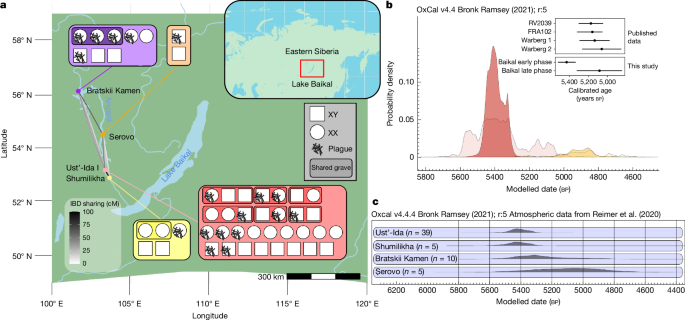
Barbieri, R. et al. Yersinia pestis: the natural history of plague. Clin. Microbiol. Rev. https://doi.org/10.1128/cmr.00044-19 (2020).
Spyrou, M. A. et al. Analysis of 3800-year-old Yersinia pestis genomes suggests Bronze Age origin for bubonic plague. Nat. Commun. 9, 2234 (2018).
Andrades Valtueña, A. et al. Stone Age Yersinia pestis genomes shed light on the early evolution, diversity, and ecology of plague. Proc. Natl Acad. Sci. USA 119, e2116722119 (2022).
Key, F. M. et al. Emergence of human-adapted Salmonella enterica is linked to the Neolithization process. Nat. Ecol. Evol. 4, 324–333 (2020).
Mühlemann, B. et al. Ancient hepatitis B viruses from the Bronze Age to the Medieval period. Nature 557, 418–423 (2018).
Harbeck, M. et al. Yersinia pestis DNA from skeletal remains from the 6th century AD reveals insights into Justinianic Plague. PLoS Pathog. 9, e1003349 (2013).
Spyrou, M. A. et al. The source of the Black Death in fourteenth-century central Eurasia. Nature 606, 718–724 (2022).
Rasmussen, S. et al. Early divergent strains of Yersinia pestis in Eurasia 5,000 years ago. Cell 163, 571–582 (2015).
Munshi-South, J., Garcia, J. A., Orton, D. & Phifer-Rixey, M. The evolutionary history of wild and domestic brown rats (Rattus norvegicus). Science 385, 1292–1297 (2024).
Rascovan, N. et al. Emergence and spread of basal lineages of Yersinia pestis during the Neolithic Decline. Cell 176, 295–305.e10 (2019).
Seersholm, F. V. et al. Repeated plague infections across six generations of Neolithic farmers. Nature 632, 114–121 (2024).
Shennan, S. et al. Regional population collapse followed initial agriculture booms in mid-Holocene Europe. Nat. Commun. 4, 2486 (2013).
Colledge, S., Conolly, J., Crema, E. & Shennan, S. Neolithic population crash in northwest Europe associated with agricultural crisis. Quat. Res. 92, 686–707 (2019).
Hama, H. O. et al. Yersinia pestis infection is not synonymous with deadly plague in Neolithic Scandinavia. Am. J. Biol Anthropol. 189, e70200 (2025).
Susat, J. et al. A 5,000-year-old hunter-gatherer already plagued by Yersinia pestis. Cell Rep 35, 109278 (2021).
Andrades Valtueña, A. et al. The stone age plague and its persistence in Eurasia. Curr. Biol. 27, 3683–3691.e8 (2017).
Bland, D. M., Miarinjara, A., Bosio, C. F., Calarco, J. & Hinnebusch, B. J. Acquisition of Yersinia murine toxin enabled Yersinia pestis to expand the range of mammalian hosts that sustain flea-borne plague. PLoS Pathog. 17, e1009995 (2021).
Weber, A. W., Katzenberg, M. A & Schurr, T. A. Prehistoric Hunter-Gatherers of the Baikal Region, Siberia (University of Pennsylvania Press, 2011).
Weber, A. W., Bazaliiskii, V. I. & Jessup, E. (eds.) Shamanka II: An Early Neolithic Cemetery on the Southwest Shore of Lake Baikal, Siberia: Archaeological and Osteological Materials (Deutsches Archäologisches Institut, 2024).
Weber, A. W. Middle Holocene hunter-gatherers of Cis-Baikal, Eastern Siberia: combined impacts of the boreal forest, bow-and-arrow, and fishing. Archaeol. Res. Asia 24, 100222 (2020).
Damgaard, P. D. B. et al. The first horse herders and the impact of early Bronze Age steppe expansions into Asia. Science 360, eaar7711 (2018).
Yu, H. et al. Paleolithic to Bronze Age Siberians reveal connections with First Americans and across Eurasia. Cell 181, 1232–1245.e20 (2020).
Kılınç, G. M. et al. Human population dynamics and Yersinia pestis in ancient northeast Asia. Sci. Adv. 7, eabc4587 (2021).
Xu, L. et al. Climate-driven marmot-plague dynamics in Mongolia and China. Sci. Rep. 13, 11906 (2023).
He, Z. et al. Distribution and characteristics of human plague cases and Yersinia pestis isolates from 4 Marmota plague foci, China, 1950–2019. Emerg. Infect. Dis. 27, 2544–2553 (2021).
Toole, R., Swamy, K., Moa, A. & Quigley, A. An overview of the first human case of bubonic plague detected in Bugat settlement, Gobi-Altai province in Mongolia. Glob. Biosecurity 6, e246 (2024).
Weber, A. W., Ramsey, C. B., Schulting, R. J., Bazaliiskii, V. I. & Goriunova, O. I. Middle Holocene hunter-gatherers of Cis-Baikal, Eastern Siberia: chronology and dietary trends. Archaeol. Res. Asia 25, 100234 (2021).
Schuenemann, V. J. et al. Targeted enrichment of ancient pathogens yielding the pPCP1 plasmid of Yersinia pestis from victims of the Black Death. Proc. Natl Acad. Sci. USA 108, E746–52 (2011).
Bronk Ramsey, C., Schulting, R. J., Bazaliiskii, V. I., Goriunova, O. I. & Weber, A. W. Spatio-temporal patterns of cemetery use among Middle Holocene hunter-gatherers of Cis-Baikal, Eastern Siberia. Archaeol. Res. Asia 25, 100253 (2021).
Turakhia, Y. et al. Ultrafast sample placement on existing tRees (UShER) enables real-time phylogenetics for the SARS-CoV-2 pandemic. Nat. Genet. 53, 809–816 (2021).
Croucher, N. J. et al. Rapid phylogenetic analysis of large samples of recombinant bacterial whole genome sequences using Gubbins. Nucleic Acids Res. 43, e15 (2015).
Didelot, X., Croucher, N. J., Bentley, S. D., Harris, S. R. & Wilson, D. J. Bayesian inference of ancestral dates on bacterial phylogenetic trees. Nucleic Acids Res. 46, e134 (2018).
Eaton, K. et al. Plagued by a cryptic clock: insight and issues from the global phylogeny of Yersinia pestis. Commun. Biol. 6, 23 (2023).
Skurnik, M., Peippo, A. & Ervelä, E. Characterization of the O-antigen gene clusters of Yersinia pseudotuberculosis and the cryptic O-antigen gene cluster of Yersinia pestis shows that the plague bacillus is most closely related to and has evolved from Y. pseudotuberculosis serotype O:1b. Mol. Microbiol. 37, 316–330 (2000).
Popli, D., Peyrégne, S. & Peter, B. M. KIN: a method to infer relatedness from low-coverage ancient DNA. Genome Biol. 24, 10 (2023).
Galdan, B., Baatar, U., Molotov, B. & Dashdavaa, O. Plague in Mongolia. Vector Borne Zoonotic Dis. 10, 69–75 (2010).
Saveljev, A., Soloviev, V., Scopin, A., Shar, S. & Otgonbaatar, M. Contemporary significance of hunting and game animals use in traditional folk medicine in north-west Mongolia and adjacent Tuva. Balk. J. Wildl. Res. 1, 76–81 (2014).
Lynteris, C. The native knowledge hypothesis. in Ethnographic Plague: configuring disease on the Chinese-Russian frontier 43–68 (Palgrave Macmillan, 2016).
Losey, R. J., Ivanov, A. V., Palesskiy, S. V. & Bazaliiskii, V. I. Geochemical analyses of marmot teeth to evaluate the potential for overlapping foraging ranges in two Siberian human cemetery populations. J. Ethnobiol. 36, 493–511 (2016).
Kehrmann, J. et al. Two fatal cases of plague after consumption of raw marmot organs. Emerg. Microbes Infect. 9, 1878–1880 (2020).
Wong, D. et al. Primary pneumonic plague contracted from a mountain lion carcass. Clin. Infect. Dis. 49, e33–e38 (2009).
Al-Hasan, M. N., Huskins, W. C., Lahr, B. D., Eckel-Passow, J. E. & Baddour, L. M. Epidemiology and outcome of Gram-negative bloodstream infection in children: a population-based study. Epidemiol. Infect. 139, 791–796 (2011).
European Centre for Disease Prevention and Control. Yersiniosis: Annual Epidemiological Report for 2018 (ECDC, 2019).
Chain, P. S. G. et al. Insights into the evolution of Yersinia pestis through whole-genome comparison with Yersinia pseudotuberculosis. Proc. Natl Acad. Sci. USA 101, 13826–13831 (2004).
Carnoy, C. et al. The superantigen gene ypm is located in an unstable chromosomal locus of Yersinia pseudotuberculosis. J. Bacteriol. 184, 4489–4499 (2002).
Carnoy, C., Mullet, C., Müller-Alouf, H., Leteurtre, E. & Simonet, M. Superantigen YPMa exacerbates the virulence of Yersinia pseudotuberculosis in mice. Infect. Immun. 68, 2553–2559 (2000).
Goubard, A. et al. Superantigenic Yersinia pseudotuberculosis induces the expression of granzymes and perforin by CD4+ T cells. Infect. Immun. 83, 2053–2064 (2015).
Chung, L. K. & Bliska, J. B. Yersiniaversus host immunity: how a pathogen evades or triggers a protective response. Curr. Opin. Microbiol. 29, 56–62 (2016).
Sato, K., Ouchi, K. & Taki, M. Yersinia pseudotuberculosis infection in children, resembling Izumi fever and Kawasaki syndrome. Pediatr. Infect. Dis. 2, 123–126 (1983).
Tahara, M., Baba, K., Waki, K. & Arakaki, Y. Analysis of Kawasaki disease showing elevated antibody titres of Yersinia pseudotuberculosis. Acta Paediatr. 95, 1661–1664 (2006).
Vincent, P., Salo, E., Skurnik, M., Fukushima, H. & Simonet, M. Similarities of Kawasaki disease and Yersinia pseudotuberculosis infection epidemiology. Pediatr. Infect. Dis. J. 26, 629–631 (2007).
Ono, Y. et al. Kawasaki disease caused by Yersinia pseudotuberculosis infection. QJM 113, 679–680 (2020).
Morelli, G. et al. Yersinia pestis genome sequencing identifies patterns of global phylogenetic diversity. Nat. Genet. 42, 1140–1143 (2010).
Zimbler, D. L., Schroeder, J. A., Eddy, J. L. & Lathem, W. W. Early emergence of Yersinia pestis as a severe respiratory pathogen. Nat. Commun. 6, 7487 (2015).
Armelagos, G. J., Goodman, A. H. & Jacobs, K. H. The origins of agriculture: Population growth during a period of declining health. Popul. Environ. 13, 9–22 (1991).
Hollingsworth, M. F. & Hollingsworth, T. H. Plague mortality rates by age and sex in the parish of St. Botolph’s without Bishopsgate, London, 1603. Popul. Stud. 25, 131–146 (1971).
Evans, C. M. & Evans, A. E. Plague — a disease of children and servants? A study of the parish records of St Peter upon Cornhill, London from 1580 to 1605. Contin. Chang. 34, 183–208 (2019).
Wu, L. T. A Treatise on Pneumonic Plague (Publications of the League of Nations, 1926).
Franco, M. P., Mulder, M., Gilman, R. H. & Smits, H. L. Human brucellosis. Lancet Infect. Dis. 7, 775–786 (2007).
Mahmoudi, A. et al. Plague reservoir species throughout the world. Integr. Zool. 16, 820–833 (2021).
Susat, J. et al. Neolithic Yersinia pestis infections in humans and a dog. Commun. Biol. 7, 1013 (2024).
Light-Maka, I. et al. Bronze Age Yersinia pestis genome from sheep sheds light on hosts and evolution of a prehistoric plague lineage. Cell 188, 5748–5762.e18 (2025).
Jones, K. E. et al. Global trends in emerging infectious diseases. Nature 451, 990–993 (2008).
Carlson, C. J. Climate change increases cross-species viral transmission risk. Nature 607, 555–562 (2022).
Bronk Ramsey, C. OxCal v4.4. https://c14.arch.ox.ac.uk/oxcal.html (2021).
Reimer, P. J. et al. The IntCal20 Northern Hemisphere Radiocarbon Age Calibration Curve (0–55 cal kBP). Radiocarbon 62, 725–757 (2020).
Hansen, H. B. et al. Comparing ancient DNA preservation in petrous bone and tooth cementum. PLoS ONE 12, e0170940 (2017).
Allentoft, M. E. et al. Population genomics of post-glacial western Eurasia. Nature 625, 301–311 (2024).
Margaryan, A. et al. Population genomics of the Viking world. Nature 585, 390–396 (2020).
Kapp, J. D., Green, R. E. & Shapiro, B. A fast and efficient single-stranded genomic library preparation method optimized for ancient DNA. J. Hered. 112, 241–249 (2021).
Rohland, N., Harney, E., Mallick, S., Nordenfelt, S. & Reich, D. Partial uracil–DNA–glycosylase treatment for screening of ancient DNA. Philos. Trans. R. Soc. B 370, 20130624 (2015).
Wagner, D. M. et al. Yersinia pestis and the plague of Justinian 541–543 AD: a genomic analysis. Lancet Infect. Dis. 14, 319–326 (2014).
Hosseini, P., Tremblay, A., Matthews, B. F. & Alkharouf, N. W. An efficient annotation and gene-expression derivation tool for Illumina Solexa datasets. BMC Res. Notes 3, 183 (2010).
Li, H. & Durbin, R. Fast and accurate long-read alignment with Burrows–Wheeler transform. Bioinformatics 26, 589–595 (2010).
Li, H. et al. The Sequence Alignment/Map format and SAMtools. Bioinformatics 25, 2078–2079 (2009).
Quinlan, A. R. & Hall, I. M. BEDTools: a flexible suite of utilities for comparing genomic features. Bioinformatics 26, 841–842 (2010).
Fu, Q. et al. A revised timescale for human evolution based on ancient mitochondrial genomes. Curr. Biol. 23, 553–559 (2013).
Korneliussen, T. S., Albrechtsen, A. & Nielsen, R. ANGSD: Analysis of Next Generation Sequencing Data. BMC Bioinformatics 15, 356 (2014).
Jónsson, H., Ginolhac, A., Schubert, M., Johnson, P. L. F. & Orlando, L. mapDamage2.0: fast approximate Bayesian estimates of ancient DNA damage parameters. Bioinformatics 29, 1682–1684 (2013).
Skoglund, P., Storå, J., Götherström, A. & Jakobsson, M. Accurate sex identification of ancient human remains using DNA shotgun sequencing. J. Archaeol. Sci. 40, 4477–4482 (2013).
Weissensteiner, H. et al. HaploGrep 2: mitochondrial haplogroup classification in the era of high-throughput sequencing. Nucleic Acids Res. 44, W58–63 (2016).
Weissensteiner, H. et al. Contamination detection in sequencing studies using the mitochondrial phylogeny. Genome Res. 31, 309–316 (2021).
Price, A. L. et al. Principal components analysis corrects for stratification in genome-wide association studies. Nat. Genet. 38, 904–909 (2006).
Rubinacci, S., Ribeiro, D. M., Hofmeister, R. J. & Delaneau, O. Efficient phasing and imputation of low-coverage sequencing data using large reference panels. Nat. Genet. 53, 120–126 (2021).
Browning, B. L. & Browning, S. R. Detecting identity by descent and estimating genotype error rates in sequence data. Am. J. Hum. Genet. 93, 840–851 (2013).
Ringbauer, H., Novembre, J. & Steinrücken, M. Parental relatedness through time revealed by runs of homozygosity in ancient DNA. Nat. Commun. 12, 5425 (2021).
Sikora, M. et al. The spatiotemporal distribution of human pathogens in ancient Eurasia. Nature 643, 1011–1019 (2025).
Breitwieser, F. P., Baker, D. N. & Salzberg, S. L. KrakenUniq: confident and fast metagenomics classification using unique k-mer counts. Genome Biol. 19, 198 (2018).
Langmead, B. & Salzberg, S. L. Fast gapped-read alignment with Bowtie 2. Nat. Methods 9, 357–359 (2012).
Van der Auwera, G. A. et al From FastQ data to high confidence variant calls: the Genome Analysis Toolkit best practices pipeline. Curr. Protoc. Bioinformatics 43, 11.10.1–11.10.33 (2013).
Kozlov, A. M., Darriba, D., Flouri, T., Morel, B. & Stamatakis, A. RAxML-NG: a fast, scalable and user-friendly tool for maximum likelihood phylogenetic inference. Bioinformatics 35, 4453–4455 (2019).
Fitch, W. M. Toward defining the course of evolution: minimum change for a specific tree topology. Syst. Biol. 20, 406–416 (1971).
Sankoff, D. Minimal mutation trees of sequences. SIAM J. Appl. Math. 28, 35–42 (1975).
McBroome, J. et al. A daily-updated database and tools for comprehensive SARS-CoV-2 mutation-annotated trees. Mol. Biol. Evol. 38, 5819–5824 (2021).
Garrison, E. et al. Building pangenome graphs. Nat. Methods 21, 2008–2012 (2024).
Garrison, E. et al. Variation graph toolkit improves read mapping by representing genetic variation in the reference. Nat. Biotechnol. 36, 875–879 (2018).
Sirén, J. et al. Pangenomics enables genotyping of known structural variants in 5202 diverse genomes. Science 374, abg8871 (2021).
Buikstra, J. E. & Ubelaker, D. H. Standards for Data Collection from Human Skeletal Remains (Arkansas Archaeological Survey, 1994).
Schaefer, M., Black, S. & Scheuer, L. Juvenile Osteology, A Laboratory and Field Manual (Academic Press, 2009).
Brooks, S. & Suchey, J. M. Skeletal age determination based on the os pubis: A comparison of the Acsádi-Nemeskéri and Suchey-Brooks methods. Hum. Evol. 5, 227–238 (1990).
Katz, D. & Suchey, J. M. Age determination of the male os pubis. Am. J. Phys. Anthropol. 69, 427–435 (1986).
Buckberry, J. L. & Chamberlain, A. T. Age estimation from the auricular surface of the ilium: a revised method. Am. J. Phys. Anthropol. 119, 231–239 (2002).
Lovejoy, C. O., Meindl, R. S., Pryzbeck, T. R. & Mensforth, R. P. Chronological metamorphosis of the auricular surface of the ilium: a new method for the determination of adult skeletal age at death. Am. J. Phys. Anthropol. 68, 15–28 (1985).
Meind, R. S. & Lovejoy, C. O. in Age Markers in the Human Skeleton (ed. Iscan, M. Y.) 137–168 (Charles C. Thomas, 1989).
Mann, R. W., Symes, S. A. & Bass, W. M. Maxillary suture obliteration: aging the human skeleton based on intact or fragmentary maxillae. J. Forensic Sci. 32, 148–157 (1987).
Krogman, W. & Iscan, M. Y. The Human Skeleton in Forensic Medicine (Charles C Thomas, 1986).
Meind, R. S. & Lovejoy, C. O. Ectocranial suture closure: a revised method for the determination of skeletal age at death based on the lateral-anterior sutures. Am. J. Phys. Anthropol. 68, 57–66 (1985).
Brock, F., Higham, T., Ditchfield, P. & Ramsey, C. B. Current pretreatment methods for AMS radiocarbon dating at the Oxford Radiocarbon Accelerator Unit (Orau). Radiocarbon 52, 103–112 (2010).
Weber, A. W. et al. Chronology of middle Holocene hunter-gatherers in the Cis-Baikal region of Siberia: corrections based on examination of the freshwater reservoir effect. Quaternary 419, 74–98 (2016).
Schulting, R. J., Ramsey, C. B., Bazaliiskii, V. I., Goriunova, O. I. & Weber, A. Freshwater reservoir offsets investigated through paired human–faunal 14C dating and stable carbon and nitrogen isotope analysis at Lake Baikal, Siberia. Radiocarbon 56, 991–1008 (2014).
Schulting, R. J. et al. Freshwater reservoir effects in Cis-Baikal: an overview. Archaeol. Res. Asia 29, 100324 (2022).
Ramsey, C. B. Methods for summarizing radiocarbon datasets. Radiocarbon 59, 1809–1833 (2017).