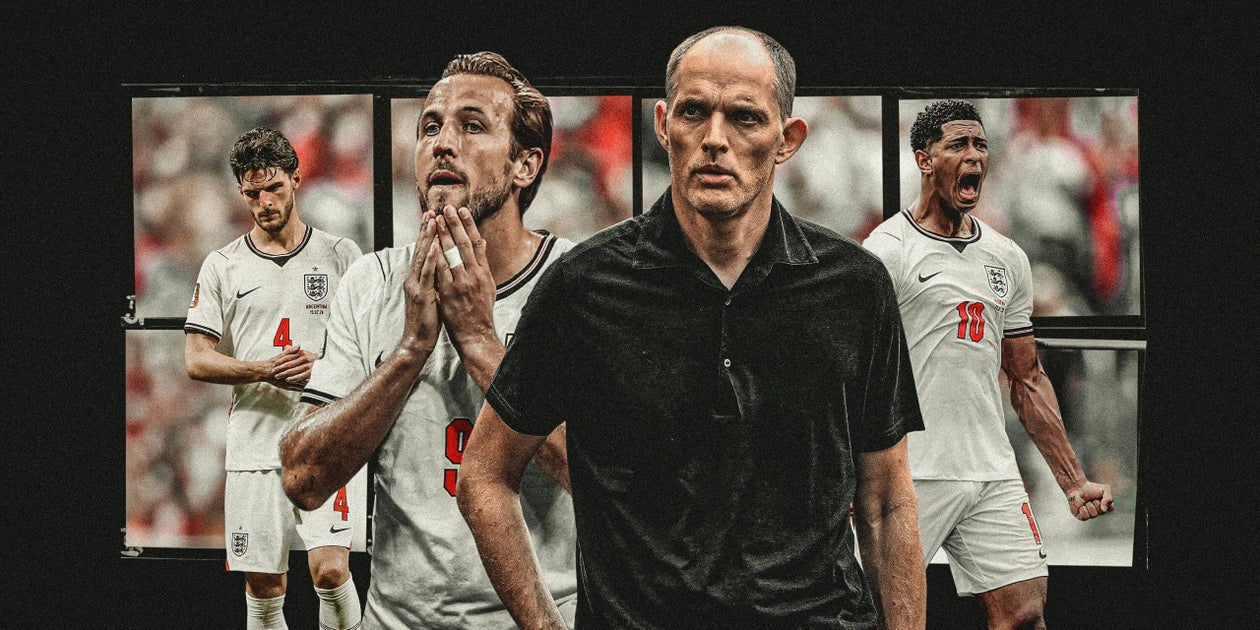
The Football Association was not shy in trumpeting its ambition when appointing Thomas Tuchel in October 2024.
English football’s governing body said it was aiming for this Sunday’s World Cup final — hence it wanted an elite manager, someone who had won things, someone to give them the best chance of a first World Cup triumph for 60 years.
Its first target was Pep Guardiola, with whom there was a verbal agreement, before he decided to renew with Manchester City. That led it to Tuchel, a Champions League winner in his own right, instead.
But England will not be at MetLife Stadium, a few miles from Manhattan in New Jersey, for the World Cup final this weekend. They will be in Miami, facing France in the third-place play-off, an obligation they also had to fulfil, with Belgium the opponents, during Tuchel predecessor Gareth Southgate’s first World Cup eight years ago.
Back then, there was a sense of novelty about the play-off, a new experience for players who had been on an adventure together. This time, it is a burden on a group who were very clear about their ambitions for this tournament. And it is perhaps because of those ambitions, and the failure to meet them, that so many connected to England were so frustrated after Wednesday’s timid semi-final exit to Argentina.
Tuchel was not appointed to carve out a new space for the England team or to build something to last for years. He was appointed to win the 2026 World Cup.
“One of the most disgraceful halves of English football history”
Duncan Alexander
And there was genuine confidence he would. Many players were convinced by it and Jake Reid, the president of Sporting Kansas City — the MLS team based near England’s training camp in that town who provided opposition in a mid-tournament friendly — told The Athletic that Tuchel and senior FA staff were even planning to get commemorative tattoos if England’s 60-year wait for a major trophy was ended. Was that a joke? Possibly, but the belief was real.
Tuchel is safe in his job. There were clauses in his lucrative contract that could have seen both parties end their partnership had England exited the World Cup before the quarter-finals. But despite the manner of the defeat to Argentina, which has been a source of widespread consternation back home, and the fact that Guardiola — now available after his end-of-season departure from City — would presumably still be interested in the post having previously agreed to take it, he seems certain to carry on.
The Athletic talked to multiple sources with knowledge of England’s World Cup campaign, who spoke on the condition of anonymity to protect their positions, to understand how a tournament that promised so much fell short in agonisingly familiar circumstances.
The mission, as Tuchel always said, was to “put a second star” on the England players’ match shirt — make the team world champions for a second time after 1966. When he explained this at his first meeting with the players at St George’s Park in March last year, they were wowed by his confidence and aura.
But Tuchel knew that simply having good players would never be enough. They wanted to build what they called ‘Team England’ — not just with a clear playing identity but bonded together by a higher purpose. They wanted to build a ‘brotherhood’.
This meant that from last September’s international break onwards, almost the most important thing was the commitment of the players to each other and the cause. About “killing our egos”, as winger Anthony Gordon put it when he spoke after victory over Mexico in the last 16, and “putting ourselves beneath the end goal”.
So, following a predictable win over Andorra on September 6, Tuchel was so impressed by how Gordon, Morgan Rogers and Ezri Konsa trained afterwards that they were drafted into the team for the game in Belgrade three days later. That 5-0 win against Serbia became the standard: not just for how England pressed and countered, but for the unity shown by the whole squad. How the substitutes cheered on the team during the game and the sprints they did long after the final whistle, in the fading light on a bumpy pitch, as his assistant Anthony Barry watched on from the shadows.
When Tuchel decided to stick with the same squad, rather than recalling Jude Bellingham, the following month, he was bombarded with questions. He repeatedly insisted that he was not here to “collect talent”, but to “build a team”, a Bill Belichick phrase he had picked up from a documentary about his hugely successful New England Patriots NFL team. And he said that he must “walk the talk”, a phrase that Tuchel kept returning to.

England trained hard in Miami and Kansas City during this World Cup (Richard Pelham/Getty Images)
So when Tuchel made his 50 phone calls in the last week of May, telling his long-list of potential World Cup selections who was in and who was out, he was very clear on what he wanted. Players who bought into the ‘brotherhood’ and who would travel well for a campaign that could stretch to seven weeks. Players who had a clear role in his chosen 4-2-3-1 system, whether as one of the core 15 starters or his “special operations unit” who would change games from the bench, and who must be happy with their lot, unlikely to start matches.
This meant no Phil Foden or Cole Palmer, who lost out because the other No 10s — Bellingham, Rogers and Eberechi Eze — had played better. No Trent Alexander-Arnold, who had barely featured under Tuchel. No Harry Maguire, much to his and his family’s fury. And, most crucially in the end, no Adam Wharton or Morgan Gibbs-White, two of the best English midfielders in the Premier League in recent years.
It was a squad built on commitment, both in terms of athletic capacity and team ethic. It was short on technical game-changers and on right-backs. Behind Elliot Anderson and Declan Rice, the latter coming off an exhausting season with Arsenal, the only backup central midfielders were Jordan Henderson and Kobbie Mainoo. The 35-year-old Henderson’s role was clear but Mainoo had never played a single competitive minute for Tuchel, and still hasn’t seven games later.
These were the risks the manager was willing to take.
England’s search for a World Cup base camp started with drawing a line across the middle of a map of the United States. The FA knew that this would be the hottest World Cup since USA 94. It wanted somewhere that would be sufficiently warm to prepare the squad for playing in the heat, but not so hot as to be impossible to train on some days. So, ideally, in the central band of the United States.
Then there was the matter of convenience. The FA did not want any long flights across the continent after games. It might look easier to base themselves on the east coast but what if they came second in the group and had to play a knockout tie in Los Angeles or Seattle? The risk-averse option was to stay in the middle of the country, where most flights back from games would last three hours.
The FA also wanted a hotel which it could make its own: a true base, rather than just booking out a few floors of a high-rise. Ideally, one near an airport, too. It found these things in the tranquil southern suburbs of Kansas City, with adequate training facilities 20 minutes’ drive away.
The priority then was to make the hotel feel like a home for the players during their five-week stay. In the spacious lobby area, there was a record player, where they could put on their favourite music. There was a dart board, table-football and a pool table, the latter frantically sourced from a family in the local suburbs just as England arrived.
In the outdoor space behind the building, there was a basketball court, a swimming pool (with underwater bikes to aid recovery), a jacuzzi and infrared saunas. There was a fire pit, surrounded by sofas and bean bags, where the players would play ‘Wolf’. Midfielder Bellingham also introduced the card game Skyjo to the squad.

Jordan Pickford plays darts at England’s training base (Richard Pelham/Getty Images)
There were some troubling moments. Items of kit were stolen prior to the squad’s arrival in Kansas City — including four pairs of boots, five pairs of shoes, three signed national-team jerseys estimated to be worth $5,000, a World Cup ball, a speaker and a Lego set of a Nike Air shoe — before being recovered by local police. Later in the tournament, there was another security breach when a man walked into the facility’s media centre carrying a wrench before being escorted out by security.
But overall, the feeling within the squad at their headquarters was positive. Tuchel knew that at the European Championships in his German homeland two years ago, the England camp was not always a happy one. He wanted to build something every player bought into. It is why he picked players he hoped would be good tourists, popular and selfless within the group, such as Dan Burn and Jordan Henderson, and why he did not select others he felt would not buy into the group ethic.
It is tempting after such a disappointing exit to look back for clues in the mood of the camp or the behaviour of the players. But, according to multiple sources familiar with the dynamics, it was generally a happy, united place. The fact that England started with a win against Croatia in Dallas and had good momentum through the tournament certainly helped.
Bellingham, who did not always look the happiest at Euro 2024, on or off the pitch, was fully bought into everything England did in the United States, helped by the fact that his close friend Jordan Henderson was in the squad. Indeed, the latter was a significant figure in the background, even after he broke his wrist in a fall as he jumped over a pitchside advertising hoarding after the Mexico win. After being flown back to Kansas City for surgery — Sporting Kansas City owner Cliff Illig said at a press conference that the club “had to jump through a few hoops to make sure we could find him a plane and get him back” — he stayed with the squad for the rest of the tournament.
It was a quiet and largely anonymous life out in America’s tranquil Midwest. Some players loved that they could explore the area, knowing they would not be mobbed by a crowd in the same way they would be back in the UK. The only challenge was boredom. It is a long time away from home and players generally only got to see their families on designated days off, which were only possible when England had a longer gap from one game to the next.
The biggest challenge was not for the 15 core players, but for those on the fringes. Many of them started off on-board with their roles and making positive noises. But as the time ticked by — seven weeks away overall — it got harder. Not all of them found themselves becoming integral substitutes as Burn did. And some of those players, according to sources, “started to feel as if they were making up the numbers”.
The use of Mainoo has been a particularly big talking point. He struggled to hide his disappointment as the matches slipped past without him being called upon and his forlorn trudges through post-match mixed zones — he was often one of the first players back onto the bus — became an unhappy feature of England’s tournament.

Kobbie Mainoo has had a frustrating World Cup (Shaun Botterill/Getty Images)
One source connected to the squad wondered if Tuchel considered the 21-year-old a youngster who would be happy to simply be part of a World Cup squad; others felt the Manchester United midfielder had simply not done enough to earn his trust. Either way, it was never clear what Tuchel’s plan was for the player. Instead, Mainoo saw defender Reece James being played in midfield instead of him towards the end of the tournament and failed to get minutes even when Rice was clearly struggling for fitness, despite a source close to the camp insisting he had trained well.
The problem was that these disaffected substitutes were the ones Tuchel needed at the end. And when England needed fresh attacking energy against Argentina, they stayed on the bench.
Harry Kane needed a big tournament. England’s record goalscorer arrived at this tournament having looked less than his best at Euro 2020, the 2022 World Cup and again at Euro 2024. It felt like he had more work left to do, one big step left to take.
Kane had been telling people for months that he was in the form, and shape, of his life. He had scored 61 goals for Bayern Munich last season and lifted a second Bundesliga title.
One of Kane’s most impressive attributes is his capacity to keep improving even this far into his career. That is as true off the pitch as on it. One of the stories of Tuchel’s tenure has been the 32-year-old’s growth as a captain, becoming more vocal behind the scenes than ever before, rather than just leading by example.
Tuchel sensed in the September and October camps the growth of a new dynamic, one led by Kane and Rice, one that he wanted to foster. When England sealed qualification for this tournament, winning in Latvia on October 14, Kane gave a rousing speech, telling the younger players how special a World Cup is and how they had to maintain their hunger to get to the finals this summer.
Kane took his responsibilities as captain very seriously, not least when it came to trying to keep his team-mates entertained during such a long trip away. Kane invited his good friend Ed Sheeran in to perform for the squad. NFL great Tom Brady — another A-list pal — dropped in to say hello.
‼️| Ed Sheeran is featured in the seventh episode of England’s ‘Extra Time’ where he meets the England national team and performs “Castle on the Hill”
— You can watch the full episode for free on The Official England App pic.twitter.com/egEeHn6z1W
— Ed Sheeran Access (@AccessEdSheeran) July 7, 2026
Kane also started well on the pitch, with two goals in that first game against Croatia. He explained to the players in a meeting before facing Ghana six days later the importance of breaking England’s habit of always drawing their second match at a tournament. They were not able to do that, drawing 0-0, but Kane scored his third of the competition when they beat Panama in the group finale.
His finest hour came in the first knockout game against DR Congo, scoring two brilliant second-half goals to send them to Mexico City.
At the end of that game, Kane did something he was usually reluctant to do in public, gathering the players for a huddle in the middle of the pitch. He had felt that they had not celebrated beating Panama and topping the group enough, but this was a chance to enjoy a special moment together and with the thousands of England fans. When Kane lost his voice celebrating the win at the Estadio Azteca, it felt like the public saw a new side of him.
All of which made it so frustrating that this tournament ended for Kane the same way so many now have: with the captain “heartbroken”, by his own admission, at England’s exit, and another opportunity missed. But also with England’s No 9 struggling to make an impact in the games that mattered most.
Kane’s sixth and last goal of the World Cup was his penalty at the Azteca. His last open-play goal was against DR Congo in the fourth of England’s seven matches. The Norway quarter-final was a slog in almost unplayably hot and humid conditions, but against Argentina, especially during the second-half collapse, Kane was unable to threaten, or even to help England get up the pitch and ease the pressure on their defence.
For him, as well as for England, it ended looking eerily like Croatia in the 2018 World Cup semis, Italy at the final of Euro 2020 or Spain in another Euros showpiece two years ago.
In previous tournaments, Kane has been asked to shoulder the burden of leading England’s attacking play by himself. The big difference this time is that he had a world-class partner in Bellingham.
More than any other player, Bellingham dominated the discussions going into this World Cup. Tuchel’s decision not to call him up for the October camp was, before his tactical changes during the match in Atlanta on Wednesday, the single most talked-about decision of his tenure. But he always wanted to get the best out of Bellingham, to get a hungry, focused, bought-in player, more so than the slightly distant version from Euro 2024.
Even then, it was an open question how best to use the Real Madrid midfielder at this World Cup. He had only started one competitive international in the year before the opener, a dead rubber against Albania in Tirana in November. Rogers had made the No 10 position his own during those crucial camps last autumn. Coming into this tournament, it was not clear what the best solution was. Tuchel even wondered whether the best approach might be to have Rogers starting as the No 10 and then Bellingham as an alternative to Kane up front.
But Bellingham was brilliant in the second warm-up game against Costa Rica, and Tuchel was convinced. He has started every game at the World Cup to date and proved himself a remarkably complete all-rounder, a No 10 who is both a driving box-to-box midfielder and a devastating penalty-box striker when needed. Tuchel had challenged him to be a team player, and it emphatically worked.

Tuchel knew he had to get the best out of Jude Bellingham (Shaun Botterill/Getty Images)
It started with a driving run to slam in England’s third goal in the 4-2 defeat of Croatia. He also stuck out a leg to break the deadlock against Panama and then set up the second goal for Kane. But it was in the knockout rounds, when England were struggling and needed some inspiration, that Bellingham hit a devastating new level.
In Mexico City, he scored twice in two minutes, two sharp runs to finish off counter-attacks and give England a crucial 2-0 lead. It was enough of a foothold in the game to see them through and Bellingham’s physical relentlessness, as England clung on with 10 men, appeared to encapsulate their approach. No player looked more bought-in than him.
Just as impressive was the next match against Norway. Playing in Miami’s draining heat and humidity, on a day when England poorly misfired, Bellingham scored both their goals, taking him to six for the tournament, as many as Kane.
After that game, Bellingham was asked about Tuchel’s post-match criticisms of the performance and he responded by suggesting that the manager, who retired at 25 through injury after a brief career in Germany’s second and third divisions, did not know what it was like to be out there playing. It was the only public moment of disunity over the course of the campaign. But it was striking that both Kane and Tuchel moved in the days after to defend Bellingham, to circle the wagons around him and render him blameless for the incident. It felt like a reminder of the importance of keeping him as part of the group.
Tuchel, like any elite coach, had been well aware of the prospect of failure throughout this World Cup. He had been watching Rafa, the Netflix documentary on tennis great Rafael Nadal, when he found time on flights. And the lesson he took from it was that “you will not find great athletes who did not suffer big defeats” and the sleepless nights of self-doubt they led to. Even after England scraped past New Zealand 1-0 in their opening warm-up game in Tampa on June 6, Tuchel found himself asking whether he was good enough, and what he got wrong or right.
But England started their tournament well with that win over Croatia when, for the first and last time at this World Cup, they showed over an extended period the football they wanted to play: physically intense and dominant, just like a Premier League side. When England were frustrated at the match being 2-2 at half-time, Tuchel calmly told the players to keep going. When both teams were starting to flag, Tuchel turned to his bench to kill the game.
And yet the deeper into the tournament England progressed, the further away they appeared to get from the identity that Tuchel wanted. He knew this, and was never anything other than candid about what he sought from the team. Before almost every game, he would talk about the new level he wanted to see, always with the sense that things were just about to click into place.
Tuchel said before Mexico in the round of 16 that England had been “impatient”, before Norway in the last eight that they were “stuck in thinking”, and before the Argentina semi-final that “this is the time to go for it”. Tuchel would describe the style of play he envisaged, England confidently playing through the press, using the ball intelligently, dominating in the opposition half. And yet it never quite clicked.
Of course, England were good enough to keep winning games. Tuchel always had a good sense of what to say to the players or what changes to make to help the team get over the edge. He talked about the importance of “pounding the rock” — a phrase borrowed from U.S. sport, meaning to stay patient as you try to break defences down.
That worked for the Panama and DR Congo games, when England stayed composed and ultimately their opponents cracked. It obviously helped that they had Kane and Bellingham up front, players who were good enough to win games. And Tuchel had made some impressive early changes, such as bringing on Gordon after an hour to make the incisive difference against DR Congo.

Tuchel’s tactics against Argentina were widely criticised (Justin Setterfield/Getty Images)
But the click in performance, the stepping-up to embody England’s true identity, never happened. They did not lead against DR Congo until the 86th minute. They spent most of the Mexico victory — a heroic achievement, given the circumstances — camped in their own penalty area, heading, kicking and punching the ball away. It was a great moment for Tuchel, who had proactively switched to the back five after Jarell Quansah’s 54th-minute red card to see out the win, and who told the players afterwards that this time they were “the rock”.
But it was not, as England found in the second half in Atlanta on Wednesday, a repeatable way to play. Against Norway, they were a shambles for much of the game, a reminder that Tuchel’s substitutions could be bad as well as good, before again they made it over the line via a goal in extra time.
In the end, they have played seven games and shown their best selves for precious little time of all those combined minutes: the second half of the opener with Croatia, a few spells against DR Congo when they were chasing the game and creating chances, maybe the counter-attacks in Mexico City or, at a push, extra time versus Norway.
On that basis, perhaps it should be no surprise that in that semi-final, England stopped playing. They stopped pounding the rock, and were the ones ground down instead.
Multiple sources spoken to by The Athletic have expressed shock and dismay at Tuchel’s choices in that game. Some have queried whether he deserves his reputation as a master tactician and that England’s retreat into a low defensive block after going 1-0 up was never going to work against a team of Argentina’s quality.
Centre-back Marc Guehi acknowledged his regret to reporters after the final whistle, saying the team “should have carried on pushing”, while Kane admitted “trying to hold on, at this level, is not enough”, although neither was being overtly critical of their coach.
Other sources point out England had started to drop deeper even before the second half’s hydration break. The manager himself wondered, following the game, if it is simply “not in our DNA… to take the ball, control the game and the ball”.
Thomas Tuchel’s ‘non-league’ approach against Argentina
Tim Spiers
Part of the reason for England’s collapse was circumstantial bad luck.
Tuchel never had a fully fit Rice to call upon. The Arsenal midfielder arrived with neural pain in his hamstring and then picked up a nasty stomach bug. He was struggling to make the Norway game and ended up only playing the first 45 minutes. Tuchel had built a team around Rice’s energy in midfield. Without that, the whole thing was unbalanced.
But then Tuchel decided to take Mainoo and Henderson as his only back-up central midfielders, rather than having Wharton or Gibbs-White to call upon. He was the one who picked a squad full of fast, physical options on the bench and yet when England truly needed an outlet in the second half on Wednesday, he kept them all on the sidelines. Tuchel failed to utilise the squad that he had built for himself.
To repeat, the fact is that Tuchel is safe. In January, he had been the subject of checks from Manchester United in the wake of Ruben Amorim’s sacking the previous month. Ultimately, however, he was happy and committed to England and was already in the process of agreeing a new contract, which he signed in February and takes him through to Euro 2028, a tournament which England will play on home soil and where they will, again, be among the favourites to win.
The messaging was very clear in the aftermath of the Argentina defeat that both Tuchel and the FA are committed to one another. There were clauses in his contract under which both parties could have agreed to his exit, after a good-faith negotiation that could have seen the FA step away (with Tuchel getting compensation) or the 52-year-old leave for a big opportunity elsewhere (again with the FA receiving compensation) should England be knocked out at the group stage, in the round of 32 or the last 16. An exemption was subsequently made for the latter once it became clear that England were in line to face Mexico at the Azteca in that fixture.
But given that England reached the semi-finals — for just the fourth time ever at a men’s World Cup, and third on foreign soil — none of those clauses have been activated. On paper, this was a good campaign; one that should be a stepping stone to a stronger run at those Euros in two years.
And yet the reality is that it does not feel like that right now.
There will be an FA review, as there is at the end of every tournament, and when FA chief executive Mark Bullingham described that process in Kansas City, just before the Croatia game, he admitted that not every campaign is simply reducible to the stage at which the team went out.
“It’s not possible to just have an arbitrary ‘This is what success looks like’, a level in the tournament,” Bullingham told reporters. “It’s more complicated than that.”
He pointed to the fact that Qatar 2022, when England were knocked out at the quarter-finals after a narrow 2-1 defeat to final-bound defending champions France, was probably Southgate’s best campaign, even though it was their earliest exit under him. Kane made the same point himself during this tournament.
Fans had few complaints with England’s elimination four years ago because they gave their best shot against a top team and were beaten on the fine details, with Kane missing a penalty.
But there has been widespread anguish and frustration from the public since Wednesday night because of the way that England ceded control of the game to Argentina even when 1-0 up. People will argue for years about whether it was Tuchel or the players themselves who started the retreat, but the manager locked it in with his defensive and tactical changes.
Tuchel had been strikingly popular with England fans right up until that point. Throughout Tuesday and Wednesday in Atlanta, you could hear them singing “Football’s coming home again, with Thomas Tuchel”, and yet so much of that goodwill evaporated instantly during the second half against Lionel Messi and his reigning World Cup holders.
It remains to be seen, at this weekend’s third-place play-off and then in September, when England return to action in the UEFA Nations League (with a home game against a Spain side who may arrive at Wembley as world champions), what the reaction of the crowd will be to the head coach. But the approval rating Tuchel has enjoyed up to this point is unlikely to ever return.