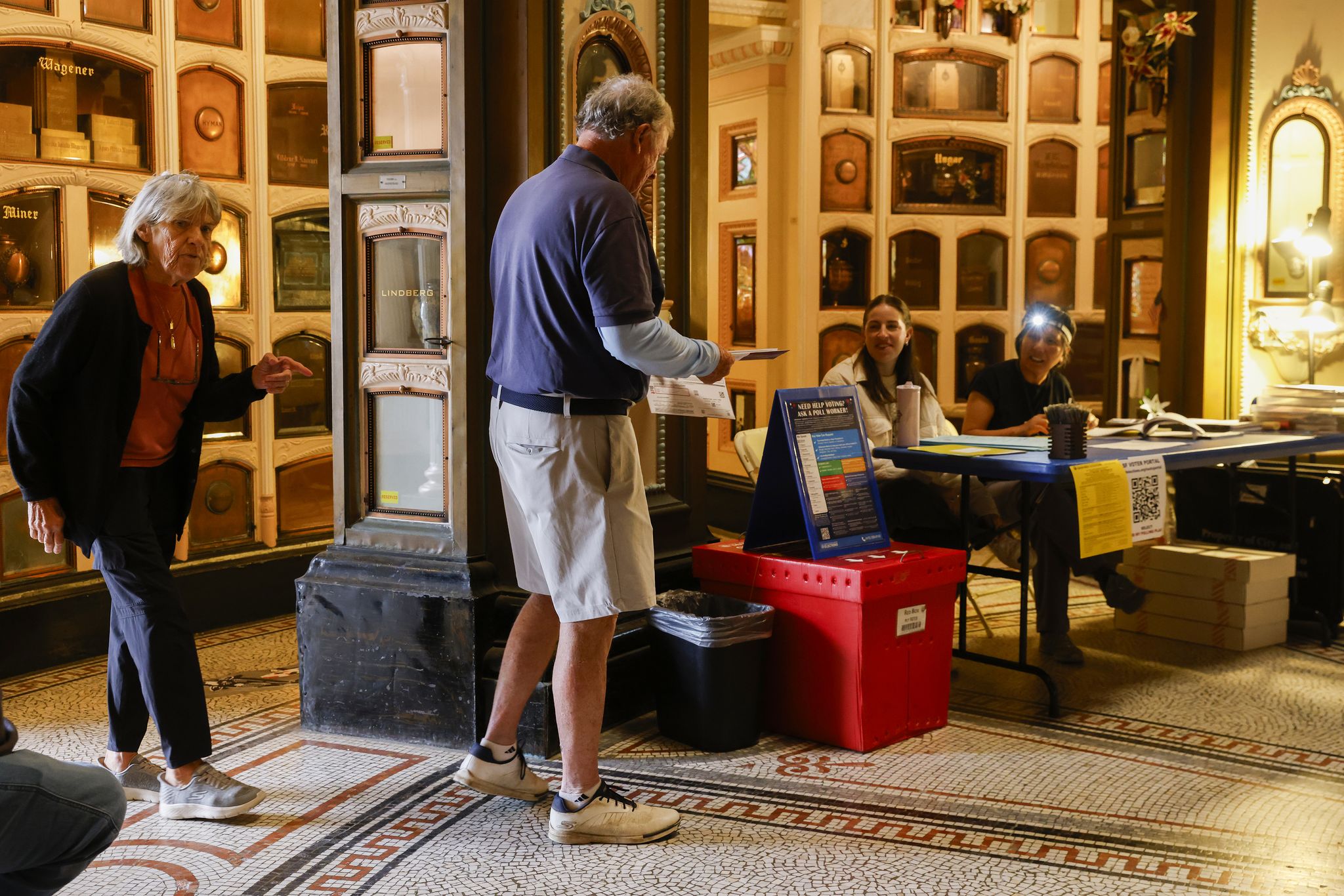

Residents arrive to cast their votes for the Primary Election at the San Francisco Columbarium & Funeral Home in San Francisco, Calif. Tuesday, June 2, 2026.
Jessica Christian/S.F. Chronicle
It’s Election Day in California, and voters across the state face a long list of decisions from statewide primaries to congressional races to consequential local races and ballot measures. Eyes across the nation will be on the race to replace term-limited Gov. Gavin Newsom, a tumultuous, wide-open gubernatorial primary unlike any California has seen in decades.
When will California election results be available? Polls close at 8 p.m. across California. Early results will begin to roll in for statewide races immediately after polls close; then, San Francisco drops its first set of election results at 8:45 p.m. As with previous elections, we will be analyzing returns and calling many local races as returns come in. But many outcomes won’t come tonight: California’s vote counting is likely to extend for weeks and, for some races and measures, it could be some time before results are official.
Article continues below this ad
Billionaire Tom Steyer’s $220 million campaign — almost entirely funded from his own pocket — is the most expensive in California’s history.
He has also beaten out the previous record for a donor in a California state election set by former eBay executive Meg Whitman, who spent $144 million on a failed bid for governor in 2010, an analysis from advertising tracker AdImpact found. (Adjusted for inflation, Whitman’s total remains higher, though that could change if Steyer progresses to the general election). Steyer’s spending blitz is also the country’s most expensive display of political advertising this year.
Steyer has spent more money on California elections than any other individual in recent history: roughly $280 million since 2005, according to a Chronicle analysis of campaign donation data.
Article continues below this ad
Former U.S. health secretary Xavier Becerra has a far smaller war chest, though it’s still in the tens of millions of dollars. After former Rep. Eric Swalwell dropped out of the race while facing sexual assault allegations, health care unions — which had supported Swalwell’s candidacy — instead put their weight behind Becerra, as have a range of other labor unions. Big business groups, including the California Association of Realtors, Uber and Meta, have also made major donations in support of Becerra.
In contrast, seven-figure donations to San Jose Mayor Matt Mahan, whose candidacy generated an initial surge of support among wealthy Silicon Valley donors, have tapered off. While dozens of billionaires have donated to support Mahan’s campaign, giving him the second-highest contribution sum in the race, he has continued to poll in the single digits.
Steyer’s ascent in the polls has been met with more than $35 million of opposition spending from “California Is Not for Sale,” a group funded by the California Association of Realtors, the California Building Industry Association, the Chamber of Commerce, PG&E and an electrical workers union.
This isn’t the first time Steyer, who has bankrolled Democratic causes for decades, has attempted to use his wealth as a springboard into public office. He spent about $250 million on a long-shot campaign for president in 2020, though he ultimately failed to gain traction with voters.
Article continues below this ad
Gov. Gavin Newsom, Speaker Emerita Nancy Pelosi and former Gov. Jerry Brown have all declined to endorse anyone in this year’s crowded race for governor.
The silence of the state’s top Democratic leaders is especially notable in a year when their party has been concerned it could be shut out of the general election. Newsom’s term limit created an open race for one of the highest-profile roles in Democratic politics and the most powerful office in the nation’s most populous state drew so many Democrats, attracting a wide field of candidates.
Registered Democrats outnumber registered Republicans in California about 45% to 25%. But in the first few months of the year, nine Democrats were splitting the liberal vote, compared with just two leading Republican candidates. In California’s open primary system, where the first- and second-place finishers advance to the general election regardless of party, that could mean that two Republicans advanced, shutting Democrats out entirely.
The big question tonight is who makes it into the top two. If it’s a Republican and a Democrat, the Democrat will likely win in November. If it’s two Democrats, California will have the first truly competitive general election for governor in more than a decade. And if it’s two Republicans, that will be a nightmare scenario for the Democrats currently running the state.
Article continues below this ad
President Donald Trump and Vice President JD Vance urged California voters Tuesday to support Republican Steve Hilton, giving the former Fox News host another national GOP boost as the state’s crowded governor’s race reached primary day.
“He will work with me and the Federal Government, the money will flow because I have confidence in him (but not any of the others!), and we will MAKE CALIFORNIA GREAT AGAIN!” Trump wrote on Truth Social.
Vance also rallied for Hilton.
Hilton, who has also been endorsed by President Donald Trump, is among the leading candidates in a race that has drawn more than 50 people seeking to replace Gov. Gavin Newsom, who is term-limited.
The primary has no clear front-runner. Other major candidates include former U.S. Health and Human Services Secretary Xavier Becerra, billionaire Democratic activist Tom Steyer, former Rep. Katie Porter, San Jose Mayor Matt Mahan and Riverside County Sheriff Chad Bianco.
California’s top-two primary system sends the two candidates with the most votes to the November election, regardless of party.
The race has centered heavily on California’s high cost of living, with Republicans calling for sharp changes after years of Democratic control and Democrats promising to lower costs while continuing to challenge the Trump administration.
Because California relies heavily on vote-by-mail ballots, the final lineup for November may not be clear Tuesday night.
Gov. Gavin Newsom signed Senate Bill 73 into law last week, making it a felony for anyone — including law enforcement — to seize ballots from a county election office. The bill included an emergency clause, which meant it went into effect immediately and will be the law of the land on Tuesday.
Newsom framed the bill as an act to safeguard California elections. The bill came in response to Riverside County Sheriff Chad Bianco’s decision to seize more than 650,000 ballots from his county’s election office in February under the guise of investigating a local group’s disputed claims of an overcount in the November 2025 special election for Prop 50.
Article continues below this ad
Bianco, a Republican, is a candidate for California governor.
The California Supreme Court eventually stopped Bianco’s office from hand-counting the ballots, but Democratic lawmakers claimed the chain of custody — and voters’ trust — was already damaged.
Newsom didn’t say Bianco’s name while signing the bill Wednesday. Instead, he referred to him as “a former member of the Oath Keepers,” the far-right militia that Bianco recently said he was proud to have been a dues-paying member of.
Under the new law, anyone who seizes ballots could be punished by up to three years in prison and a $1,000 fine. It also makes it illegal for law enforcement to search or take custody of voter rolls or voting machines without a signed warrant or agreement with election officials.

Department of Elections workers sort mail-in ballots for the California primary election at City Hall on Tuesday in San Francisco.
Gov. Gavin Newsom’s office fired back at President Donald Trump after he falsely claimed California elections and mail-in ballots are fraudulent, escalating a dispute over the state’s voting system on the eve of Tuesday’s primary.
The exchange followed a Fox News interview with Lara Trump, the president’s daughter-in-law, on Sunday in which the president criticized California’s elections and repeated his long-running attacks on mail voting.
“Their elections are a fraud, their mail-in votes are a fraud,” Trump said.
Newsom’s press office responded on X: “No, you’re just a loser.”
Trump also falsely said California does not have voting booths and that “everything’s by mail.”
California mails ballots to all active registered voters, but voters are not required to use them. The California secretary of state’s office says any registered voter may choose whether to vote by mail or at a polling place.
Los Angeles County’s registrar-recorder responded to Trump’s comments Sunday with a “MISINFORMATION ALERT,” saying vote centers are open for in-person voting in the June 2 primary.
California Attorney General Rob Bonta, a Democrat, also criticized Trump’s claim on X.
“President Trump, once again, is lying,” he wrote. “Californians have several ways to ensure their vote is counted,”
The comments come as Trump and California Democrats are already fighting over a March executive order that seeks to impose new federal rules on voter registration and mail ballots. Bonta and other Democratic attorneys general have sued to block the order, arguing that it unlawfully interferes with states’ authority to run elections.
Newsom last week signed a California law intended to limit federal access to voter rolls and election infrastructure without a court order, a move his office described as a safeguard against federal interference.
Three key polls were released in recent days and all three of them found former Health and Human Services Secretary Xavier Becerra several points ahead of both Republican former Fox News host Steve Hilton and investor Tom Steyer. PPIC has Becerra at 23%, IGS has him at 25% and Emerson shows him 28% of the vote. No other candidate received more than 22% of the vote in any of the polls.
By contrast, Katie Porter and Matt Mahan remain stuck in the low double or high single digits. Support for Riverside County sheriff Chad Bianco, a Republican, hovers at 11% to 13% across the polls.
That slight but significant edge has translated to a much more lopsided lead on another metric: betting odds on markets like Kalshi and Polymarket. On both platforms, ordinary people are putting their money where their mouth is, yielding a two-thirds probability that Becerra advances and wins the November race.
Betting markets aren’t perfect — Sacramento political strategist Paul Mitchell warns they reflect the views of “crypto bros,” as well as people who are willing to lose money to move the odds — but they have lately proved prescient.
Read more about how Becerra came from behind to lead the polls here.
In California, ballots arriving to county election offices by mail must be postmarked by Election Day — June 2 — to count under state law. County officials can receive and process the ballots for another seven days after Election Day, as long as the ballots are postmarked by Election Day. But a new U.S. Postal Service policy implemented this year under President Donald Trump has added a major caveat: It’s no longer certain that a ballot dropped into the mail on Election Day will be postmarked on Election Day.
The Postal Service said in January that operational changes — like how often mail is picked up — mean that sometimes mail pieces aren’t arriving at processing facilities the same day they’re mailed. Under the new definitions, a postmark is only added when a piece of mail is processed.
Those in rural locations farther away from central processing facilities are more likely to experience a gap between a ballot being mailed and when it’s postmarked.
Voting experts say that ideally, voters relying on standard mail should already have mailed their ballots a week before the election.

Residents head out to cast their votes for the primary election in San Francisco on Tuesday.
Take the Chronicle’s Voter Guide with you: it allows you to enter your address to see only the races you’ll be voting on and allows you to make and save your selections, plus includes links to our editorial board’s endorsements.
Need to look up your assigned polling place? You can do so here. Voting centers will be open on Election Day for in-person voting and ballot drop-off from 7 a.m. to 8 p.m.
If you want to cast your vote-by-mail ballot in-person, you can do so at a secure ballot drop box, a voting location, or your county elections office. You can find a location in your area here.
Want to fill out your mailed ballot in person? You can do so at voting centers. Take your mail-in ballot with you, and ask to vote in person instead — your mail-in ballot will be exchanged for a polling-place ballot. If you don’t bring your mail-in ballot, the California Secretary of State’s office says you will be given a provisional ballot, which will be counted after your county elections official confirms you are registered and did not vote more than once in this election.
However, election officials in at least one Bay Area county — San Francisco — say if you go to your assigned polling center or City Hall, you may vote a standard ballot in person without surrendering your vote-by-mail ballot. If you go to a different polling center, or if your name doesn’t appear on the roster, or if officials have other notes such as an address change without updated registration, you will receive a provisional ballot.
If you have questions, check with your local elections office.
How do I know my vote was received and counted? You can track the status of your ballot by visiting the state’s Where’s My Ballot website.