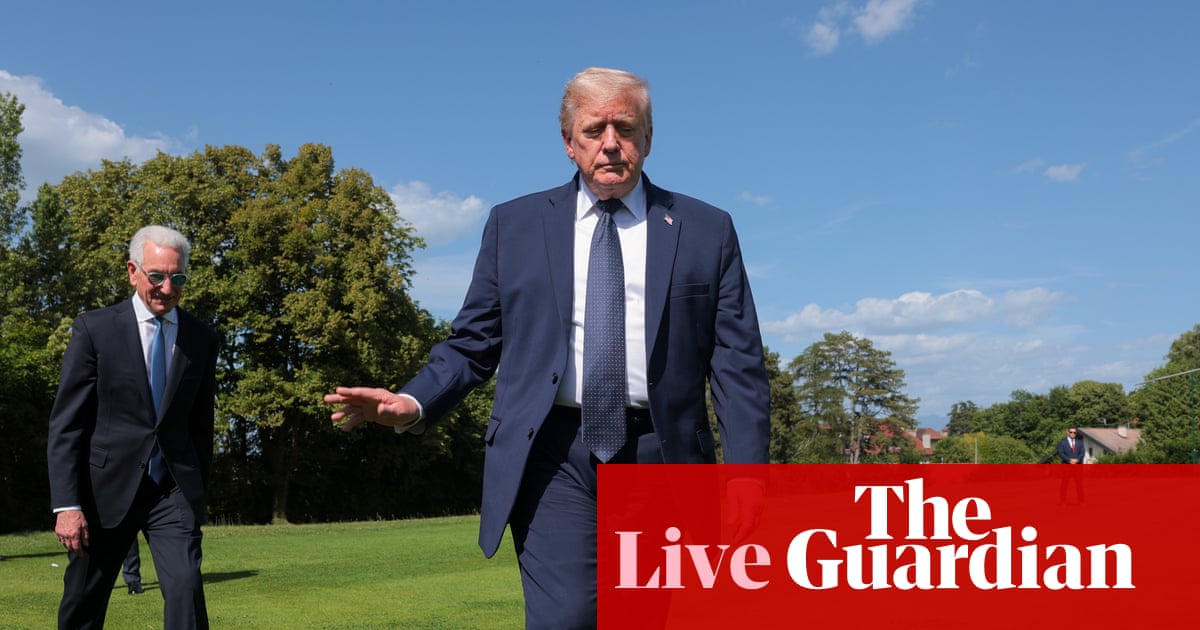
Trump claims ships carrying oil are moving out of the strait of Hormuz
In a post to Truth Social, the US president, Donald Trump, has just claimed that ships carrying oil are “starting to move” out of the strait of Hormuz, even though many shippers say the arrangement to cross the waterway remains unclear and consider it too risky for ships to commence transit again. Trump wrote:
Ships are starting to move, many loaded up with Oil, out of the Strait of Hormuz. They are going along the Southern “Highway,” which is totally safe, secure, and pristine. There are other areas of travel, also!!!
Shipping companies and insurers will feel like the strait is safer for passage after the framework peace deal with Iran is signed and the remaining mines cleared.

Key events
Israel says it has killed two Hamas commanders in strikes in Gaza
Israel’s military said it has killed two Hamas commanders in strikes in Gaza on Monday.
The Israeli Air Force identified the targets of the strikes as Saleh Ramadan Muhammad Khalifa, killed in central Gaza, and Muhammad Musa Diab al-Bil, who was killed in the north of the strip.
In a post on X, the air force said the two commanders had “planned to carry out terror attacks against IDF forces, posed an immediate threat to the forces, and were eliminated in precise strikes.”
The announcement came after Donald Trump said the tentative deal between the United States and Iran had been signed, with the text of the agreement set to be released later this week.
During the address in Paris, ahead of a G7 meeting in France, the US president said the Strait of Hormuz would be fully opened.
Today so far
-
A memorandum of understanding between the United States and Iran has been signed by president Donald Trump, vice-president JD Vance and Iranian parliament speaker Mohammad Bagher Qalibaf, a senior US official said on Monday. Speaking at the start of bilateral talks with French president Emmanuel Macron ahead of a G7 summit in France, Trump said that ships are starting to pass through the strait of Hormuz now and that by Friday, the strait “will be completely open”.
-
The deal included a ceasefire in Lebanon but did not provide for a withdrawal of Israeli troops from areas that they occupied. Lebanon’s prime minister Nawaf Salam has said diplomatic efforts with the US are continuing in order to achieve the full withdrawal of Israeli troops from territory in southern Lebanon.
-
Israeli defence minister, Israel Katz has said that “the IDF will remain in the security zones in Lebanon, Syria and Gaza – indefinitely – to defend the border and Israeli communities against jihadist elements,” the Israeli newspaper Hareetz reports. Israel currently occupies swathes of southern Lebanon and Katz said that troops won’t withdraw from the land.
-
Hezbollah has welcomed the memorandum of understanding between the United States and Iran, saying it had resulted in a comprehensive ceasefire across all fronts, including Lebanon. In a written statement, the Tehran-backed group warned Israel that it would not accept any attacks that violate Lebanon’s sovereignty or targeted its people. It said Lebanon’s inclusion in the agreement reflected Iran’s commitment to ending the war.
-
Fury has continued to mount in India over the US’s refusal to apologise for the deaths of Indian sailors killed in strikes in the strait of Hormuz, further straining relations between the two countries as their leaders meet at the G7 summit in France this week.
-
Global oil prices have tumbled amid fresh hopes that a US-Iran peace deal may end the greatest energy supply crisis in the history of the market. The price of Brent crude dropped below $84 a barrel as the new trading week began in financial centres across Asia-Pacific.
The US and Iran have reached a tentative deal to end the conflict in the Middle East, but competing claims from Donald Trump and Tehran have left the details shrouded in uncertainty.
Questions remain over the reopening of the strait of Hormuz, Israel’s withdrawal from Lebanon, and the future of Iran’s nuclear programme.
Nosheen Iqbal speaks to the Guardian’s senior international correspondent Julian Borger…
Trump says strait of Hormuz will be ‘completely open’ on Friday
The strait of Hormuz will be “completely open” from Friday after a deal between Iran and the US to end the Middle East war that limited shipping in the critical bottleneck, president Donald Trump has said.
Speaking at the start of bilateral talks with French president Emmanuel Macron ahead of a G7 summit in France, Trump added “I don’t think we will need much help” on keeping the strait open, after London and Paris proposed a joint naval mission.

Andrew Roth
The US and Iran have signed a deal to open the Strait of Hormuz in exchange for a lifting of a US naval blockade on Iran, senior administration officials have said, as part of a Memorandum of Understanding (MOU) that will allow free movement through the crucial waterway for the next 60 days.
The deal was signed electronically by US president Donald Trump, vice-president JD Vance, and Iranian parliament speaker Mohammed Ghalibaf. A formal signing ceremony is set for Geneva on Friday.
“We have now signed a memorandum of understanding with Iran,” an official said during a briefing call with reporters. “All the details of the agreement have not been put out yet. They will be put out in the next 24-48 hours.”
Technical discussions led by Vance from the US side will begin later this week. That includes the more thorny issues of the fate of Iran’s nuclear program, which Trump has declared must never be able to produce a nuclear weapon.
It would also include provisions to lift sanctions and unfreeze billions of dollars in frozen assets but officials said that would be tied to “Iran meeting their commitments.”
“We discussed the possibility of releasing frozen funds, sanctions relief, you know, a big $300 billion fund to rebuild their country, and all of these things are going to be tied to performance,” one of the officials said.
They said that zero funds had been released as a result of signing the MOU. “We don’t pay for play, we don’t pay them to show up at a meeting,” the official said.
The deal has been heavily scrutinised as an official copy of the Memorandum of Understanding (MOU) has not yet been released publicly. But administration officials claimed it contained provisions that would prevent Iran from achieving a nuclear weapon.
“We have an Iran that is substantially weakened,” one adminsitration said praising the deal. “In order to rebuild (their nuclear program), they need a lot of money, and this deal really has two pathways.” The first option, the official said, is that Iran don’t get any money won’t have the resources to rebuild their industrial base or their nuclear weapons program. Option two is they are “invited into the world economy with all the prosperity that comes along with it, but only if they provide us the enforcement verification mechanism to ensure they’re not going to rebuild that nuclear weapon. So it’s a win either way for the United States.”
The deal also included a ceasefire in Lebanon but did not provide for a withdrawal of Israeli troops from areas that they occupied.
“The deal is a ceasefire, and it will not be a one-way ceasefire, meaning that if Iran is not able to control Hezbollah, and if they attack Israeli positions or Israeli towns, Israel will have the right to defend themselves and respond,” the officials said.
The officials credited the US military operation in the region and the “degradation” of Iran’s economy with providing a breakthrough in the negotiations. They also credited Pakistani and Qatari mediation, while saying that they were unhappy with Oman’s earlier efforts to broker a deal.
“We were very unhappy with the job the Omanis did,” an official said. “We felt they were very duplicitous and almost like employees of the Iranians in the way that they maneuvered. So we kind of threw them out of this process.”
A framework peace deal between the US and Iran has been reached, Donald Trump and senior Iranian officials have said, bringing the 15-week conflict to a tentative end and offering hope of relief for the Middle East and the world economy.
Thousands of people have been killed in the conflict, most of them in Iran and Lebanon, since US and Israeli forces first attacked Iran on 28 February.

William Christou
Hours after the US-Iran ceasefire was announced, residents of south Lebanon began to race back to their villages. One man filmed as he drove into the entrance of Harees, his arrival interrupted as the car in front of him suddenly veered off the road. An Israeli armoured vehicle was parked in the middle of the road less than 100 metres ahead; he scrambled to turn around.
“It was packed with explosives. I guess they still want to blow things up,” said Abdullah al-Ali, a municipal official in Harees. Ali added that the entrance to the town was blocked off after two other explosive-laden vehicles left by the Israelis were discovered in the area.
The Lebanese army and civil defence told people not to return to their villages, warning that the war, which had so far claimed almost 3,800 lives in Lebanon, was not yet over. Their point was punctuated by the Israeli shelling that met people attempting to return to their homes south of the city of Nabatieh, still occupied by Israeli soldiers.
It was the third ceasefire declared in Lebanon in less than two months; the fourth in two years. This time, war-weary Lebanese did not greet the apparent truce as they had before, with fingers held up in a V for victory sign, but with a question. Would it last?
Trump, Vance and Iran’s parliament speaker signed the MoU
The memorandum of understanding between the United States and Iran has been signed by president Donald Trump and vice-president JD Vance and Iranian parliament speaker Mohammad Bagher Qalibaf, a senior US official said on Monday.

Patrick Wintour
The basic structure of the US-Iran deal reached late on Sunday – a return to the prewar status quo – has been on offer from Iran for more than a month. So has the specific architecture: an immediate unwinding of the consequences of the US-Israeli war through the reopening of the strait of Hormuz and a deferral of the actual negotiations on Iran’s nuclear programme, the ostensible cause of the war.
The concept of a 60-day ceasefire to resolve these issues has also been a fixture for more than a month.
But it has taken the mounting pressure on the US and Iranian economies for both sides to recognise politically that a return to all-out war was unlikely to resolve the impasse, and if so, compromises would have to be struck.
Both sides had to relent on the complex issues holding up a deal: the future governance of the strait of Hormuz, the economic sweeteners – including sanctions relief – that needed to be offered to Iran, and the agenda for the deferred nuclear talks, including what preconditions would be set and how much ambiguity could be tolerated.
Iranian negotiators will now travel to Doha to try to work out some of the shaky implementation aspects of the deal before a signing ceremony on Friday in Geneva – the city US negotiators left on 28 February, the day the war began, when a far superior nuclear offer to now was being offered by the Iranians.
Shipping through the strait of Hormuz remained virtually at a standstill on Monday, tracking platforms indicated, despite US president Donald Trump’s claim that crossings were resuming under his deal to end the war with Iran.
Trump said Monday that loaded oil tankers were “starting to move” out of the strait, apparently on a route near to Oman, in a post on his Truth Social platform.
Announcing the accord with Iran on Sunday, he had said that the strait could reopen immediately after the scheduled signing of the agreement on Friday.
At 2pm GMT on Monday, tracking firm Kpler had detected only one commodities carrier crossing the strait during the day with its transponder switched on.
An Israeli drone strike targeted a car in southern Lebanon, killing its driver, Lebanese security sources and state media reported on Monday.
The strike was the first reported deadly Israeli attack in Lebanon since the announcement of the US-Iran agreement.
Here are some of the latest images being sent to us over the newswires from Lebanon, where displaced people have begun to make their way back to their homes despite fears of a resumption of Israeli attacks occurring in the south:
Gaza’s health ministry said in its latest update that at least six people were killed and six others injured in Israeli attacks across the territory over the past day. It said one other person’s body had been recovered in that time frame.
The health ministry says 992 people have been killed in Israeli attacks since the ‘ceasefire’ between Israel and Hamas came into effect in October 2025.
It says that 73,003 people, many of whom were women and children, have been killed in Israeli attacks across Gaza since October 2023, when Israel launched its assault on the territory following the Hamas-led attack on southern Israel on 7 October 2023, in which about 1,200 people were killed and 251 taken hostage.
Lebanon’s prime minister Nawaf Salam has said diplomatic efforts with the US are continuing in order to achieve the full withdrawal of Israeli troops from territory in southern Lebanon. Speaking to his cabinet, Salam said:
Since the start of the war imposed on Lebanon, the Lebanese government has continuously worked to bring it to an end and to spare Lebanon and the Lebanese people further harm.
Today, we hope that the ceasefire announced by the United States of America and the Islamic Republic of Iran will succeed in putting an end to this war and stopping the killing, destruction, displacement, and all the tragedies and suffering inflicted upon the Lebanese people.
I can only extend my sincere thanks to all those who contributed to reaching this outcome.
As we have mentioned previously in the blog, Israel’s defence minister, Israel Katz, said this morning that Israeli military forces will not withdraw from a vast swathe of territory they have seized in southern Lebanon despite the US-Iran agreement.
Speaking on the first day of the G7 summit in in Évian-les-Bains, French president Emmanuel Macron said a joint France-UK mission to ensure the strait of Hormuz opens was prepared to deploy “very quickly”, with the French flagship aircraft carrier Charles de Gaulle ready to be in the zone “on a timescale of two to three days”.
“We do every thing so that this accord is a reality and that Hormuz can reopen,” Macron said. He added that any deployment would be done with the agreement of the US and “in parallel with the Iranians”, ensuring that “the reopening of Hormuz to take place peacefully and in a lasting manner”.
In an interview with CNBC, the US vice president, JD Vance, said the “two big wins” for the American public is the immediate reopening of the strait of Hormuz, which has seen oil prices fall already, and the “long term commitment” that Iran will never develop or procure a nuclear weapon.
He said:
The agreement is fundamentally built around a two step verification process. We say to the Iranians you are welcome to have access to an unsanctioned economy, you are welcome to be re-invited into the world economy. But only if you honour the commitments that you make in this agreement. So, that is the leverage point and simultaneously the enforcement mechanism we have over their nuclear programme.
Vance went on to say that the expectation is for the strait to be “toll-free” for “the long term”, echoing Donald Trump’s comments yesterday. “That’s the sort of thing that we are going to figure out in these technical negotiations,” he said.
Iranian state media has reported the strait will open to toll-free transits for commercial vessels for a 60-day period. The waterway will be managed by Iran and Oman after that period and its exact management system from then on is unclear.
Trump claims ships carrying oil are moving out of the strait of Hormuz
In a post to Truth Social, the US president, Donald Trump, has just claimed that ships carrying oil are “starting to move” out of the strait of Hormuz, even though many shippers say the arrangement to cross the waterway remains unclear and consider it too risky for ships to commence transit again. Trump wrote:
Ships are starting to move, many loaded up with Oil, out of the Strait of Hormuz. They are going along the Southern “Highway,” which is totally safe, secure, and pristine. There are other areas of travel, also!!!
Shipping companies and insurers will feel like the strait is safer for passage after the framework peace deal with Iran is signed and the remaining mines cleared.
Hezbollah has welcomed the memorandum of understanding between the United States and Iran, saying it had resulted in a comprehensive ceasefire across all fronts, including Lebanon.
In a written statement, the Tehran-backed group warned Israel that it would not accept any attacks that violate Lebanon’s sovereignty or targeted its people.
It said Lebanon’s inclusion in the agreement reflected Iran’s commitment to ending the war.