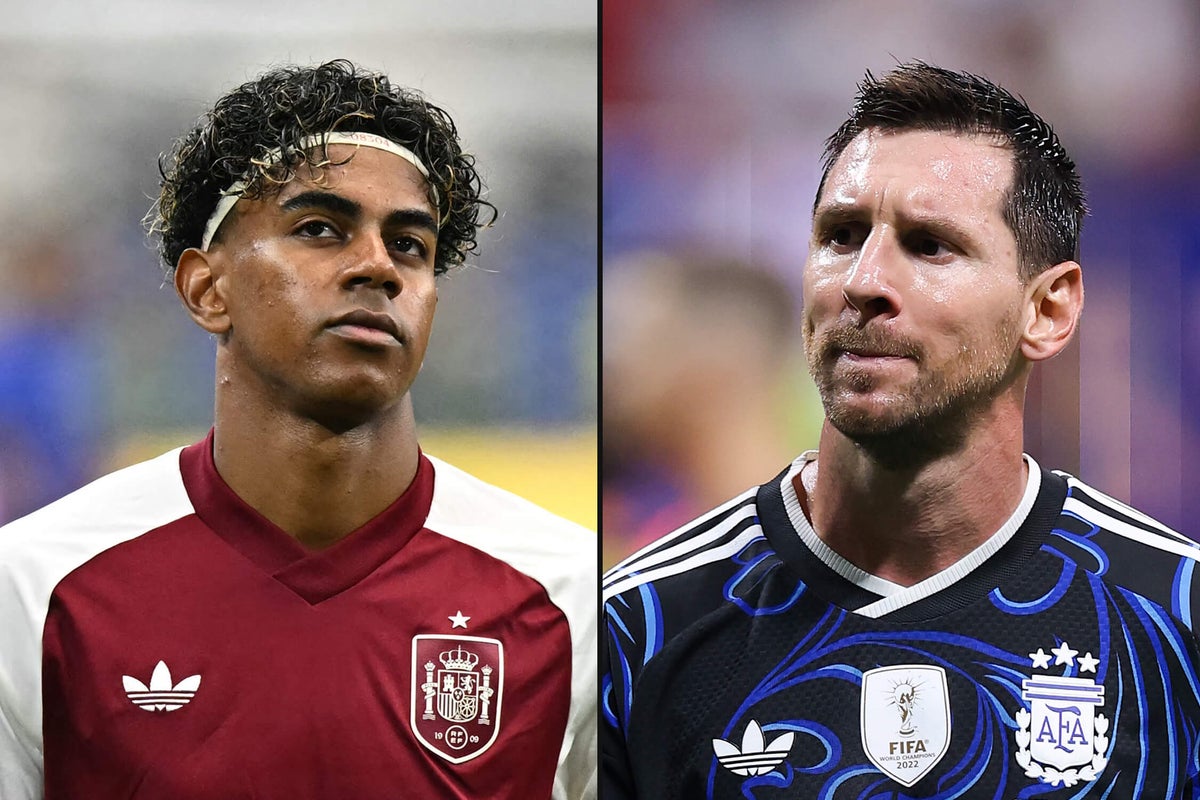
Football’s greatest prize is up for grabs at MetLife Stadium on Sunday. It is Spain vs Argentina in the World Cup final.
Europe’s champions take on their South American counterparts. Lionel Messi, 39, faces 19-year-old Lamine Yamal — perhaps the closest possible heir to his legend at Barcelona.
It will be their first meeting on the pitch, but — incredibly — Messi helped bathe a five-month-old Yamal as part of a charity photoshoot back in December 2007.
Get free access to the most comprehensive World Cup coverage in The Athletic app
Spain, who have only conceded one goal in seven matches at the tournament, are looking to win the World Cup for a second time, 16 years on from their first success.
Argentina, meanwhile, are defending the title they won in 2022 — their third in total — in a match that is widely expected to mark Messi’s farewell from the game’s biggest stage.
We take a closer look at this mouthwatering tie, and where it might be decided…
What’s the key info I need to know?
Round: World Cup final
World rankings: Spain (FIFA ranking: 2nd) vs Argentina (1st)
Venue: MetLife Stadium, New York, New Jersey
Date: Sunday, July 19
Kick-off: 12pm PT/3pm ET/8pm BST
How did Spain reach the final?
Spain’s World Cup began with a big shock, as they were held to a goalless draw by African competition debutants Cape Verde, ranked 67th in the world.
They got up and running against Saudi Arabia, scoring three times before the first cooling break, with centre-forward Mikel Oyarzabal scoring twice and assisting for Yamal. An own goal from Saudi defender Hassan Altambakti completed the 4-0 scoreline.
Luis de la Fuente’s team then made sure they topped Group H by eking out a tough 1-0 victory over a stubborn Uruguay side in game three, thanks to Alex Baena’s snapshot.
The idea was always for the team to grow into the tournament, as key players including Yamal and Rodri returned to 100 per cent sharpness after recent injuries.
The improvement continued with a 3-0 hammering of Austria in the round of 32, including a double from centre-forward Oyarzabal and right-back Pedro Porro finishing off a neat team move.
The last 16 brought a tight and tense 1-0 win over Iberian neighbours Portugal, decided by substitute Mikel Merino’s 91st-minute goal, which ended Cristiano Ronaldo’s World Cup career.

Yamal and Cristiano Ronaldo embrace after Spain’s 1-0 win in the last 16 (Ronaldo Schemidt/AFP via Getty Images)
Spain upped their level further in the quarter-finals. Although a mistake by Belgium’s replacement keeper Senne Lammens helped ‘supersub’ Merino score late on again, the 2-1 final result did not fully reflect how well they played against a team who had eliminated the United States in the previous round.
The biggest test came against pre-tournament favourites France in Tuesday’s semi-final. Spain matched the occasion with an outstanding display in both attack and defence, as 2024 Ballon d’Or winner Rodri helped his team control the midfield completely, frustrating superstar French attackers Kylian Mbappe, Ousmane Dembele and Michael Olise.
Yamal’s persistence and intelligence won a penalty which Oyarzabal converted, and playmaker Dani Olmo set up Porro’s second-half strike to seal a fully deserved 2-0 victory.
Dermot Corrigan
How did Argentina reach the final?
There’s been more than a whiff of survival about Argentina at the World Cup, which is why their powers of progression are so remarkable. They’ve been backed into a corner more than once, and in a number of ways (physically and tactically), yet always able to find solutions.
The group stage was a doddle, as it was always likely to be in a pool containing Algeria, Austria and Jordan. Messi ran riot, their defence experienced very little stress and it was nailed on that they would top the group from the moment they saw off Algeria at a canter, winning 3-0.
The nature of the World Cup draw, with teams seeded by FIFA for the first time, meant that trouble wasn’t likely to occur until the knockouts — when it absolutely did.

Argentina trailed Egypt 2-0 before coming back to win 3-2 (Elsa/Getty Images)
Come the last 32, the pressure escalated drastically. Argentina were pushed hard by Cape Verde, and their legs threatened to give up on them in extra time. They were borderline eliminated in the last 16 before fighting back from 2-0 down against Egypt (and no mention of that tie can pass without reference to certain refereeing decisions in it).
They were in trouble again in their quarter-final against Switzerland, who had impetus behind them at 1-1, only for Breel Embolo to pick up a red card. And their semi-final victory over England was plucked from another incredibly precarious position.
Messi’s influence is clearly critical. Eight goals and four assists are the definition of carrying a team, but just as vital to Lionel Scaloni is Argentina’s knack of hanging in, riding out storms and coming up with late goals. If this isn’t a name-on-the-trophy run, what is?
Phil Hay
How to watch on TV
United States: 12pm PDT/3pm EDT: Fox (English), Telemundo (Spanish)
Canada: 12pm PDT/3pm EDT: TSN/RDS
Mexico: 1pm CST: Televisa Univision/TV Azteca
United Kingdom: 8pm BST: BBC One/ITV
What should we expect from Spain?
Control, cohesiveness, and a dogged intensity off the ball.
Spain’s identity as a possession-dominant, short-passing side is well established, a principle they have adhered to in this tournament, averaging 63.7 per cent of the ball across their seven matches.
This dominance is physically and mentally exhausting for opponents, who are left chasing shadows as Spain’s technicians pass around them with precision. But their approach is not just about grinding teams down and waiting for gaps to appear. Spain’s movement is dynamic, with players swapping positions and making surging runs that pull defensive structures apart.

Dani Olmo has been one of Spain’s best performers in midfield and attack (Aric Becker / AFP via Getty Images)
Deep runs from full-backs into advanced areas have been particularly fruitful. Porro’s goal against France in the semi-final came from exactly that route, while Marc Cucurella has been even more active on the opposite flank, making 139 runs behind defensive lines, the fifth-most of any player at the tournament. Despite that volume, opponents are still struggling to track those movements or decide who should take responsibility.
Spain’s obsession with controlling possession is matched by an equally fierce commitment to winning it back. De la Fuente’s forwards press aggressively, while centre-backs Pau Cubarsi and Aymeric Laporte hold a high defensive line, squeezing the pitch and pinning their opponents back. Holding it all together is the irrepressible Rodri, sweeping up loose balls and snuffing out counter-attacks with a positional awareness few central midfielders match.
Spain have had the most well-defined playing style at this tournament, with every player knowing their exact responsibilities and sharing a strong understanding with their team-mates. Add to that the sprinkling of stardust provided by Yamal, and they will be a daunting proposition for Argentina to overcome.
Conor O’Neill
What should we expect from Argentina?
A feisty combativeness, a never-say-die attitude, and of course, Messi. Scaloni’s side have laboured through long stretches of games only to come alive late on, with 12 of their 19 goals arriving after the 75th minute of normal time.
Sit off them, as England fatally did late in the semi-final, and they boast enough quality in midfield to knock the ball around comfortably, creating a steady stream of chances. A tournament-high 5.4 passes per sequence speaks to their composure, patiently moving the opposition around until an opening appears.
Those combinations are concentrated through the middle, where Messi generally lurks, with Argentina directing a smaller share of their passing towards the flanks than any other team.

While Messi’s seemingly boundless talent has dragged them to the final, the 39-year-old’s physical limitations mean they do not operate with the same aggressive high press as Spain. They win possession in the final third 2.9 times per game, roughly half Spain’s rate. Instead, they sit off before snapping into challenges (and yes, sometimes fouls) once possession moves into midfield.
Despite being one of the smallest teams at the tournament, Argentina have enjoyed considerable success in the air, scoring four headed goals. Three of those, including Lautaro Martinez’s late winner against England, have come from Messi crosses, with his pinpoint delivery making them dangerous from wide areas even if their play is concentrated through the middle.
The focal point is obvious, but it is reductive to view them solely as a one-man team. Julian Alvarez provides bustling energy and quality up top, Enzo Fernandez has popped up with crucial late goals, and Emi Martinez is a confident presence between the posts.
Spain are the more complete side, but Argentina boast an indefatigable spirit and an uncanny ability to conjure moments of individual quality when they need them most.
Conor O’Neill
Who is the star player for each team?
For Argentina, while the supporting cast have pitched in with big moments, this is undoubtedly, and once again, the Messi show.
Joint leading the Golden Boot race with eight goals (level with Mbappe), Messi has scored or assisted 12 of Argentina’s 19 goals, with the graphic below showing that he is both their chief creator and primary threat, averaging the most shots and chances created per 90.

Spending the majority of the tournament strolling about, he can appear, to the uninitiated onlooker, every inch the 39-year-old whose physical capabilities can no longer cut it at the elite level.
But this is part of the magician’s sleight of hand, springing into life when his country need him most. Against England, he completed 10 take-ons, more than any player in any of the tournament’s other 101 games, and his ability to hold off opponents with his remarkable core strength and weave away in either direction remains as potent as ever.
For Spain, Yamal brings the attacking fireworks, but Rodri is De la Fuente’s most important player. The Manchester City midfielder is unflappable at the heart of Spain’s build-up, providing the composure and control from which they launch their attacks. According to FIFA’s data, Rodri has completed 47 passes under pressure per match, the most of any player at the tournament.

Rodri won the 2024 Ballon d’Or (Mauro Pimentel/AFP via Getty Image)
Calm on the ball, Rodri is a ferocious monster off it, hoovering up second balls with his sharp anticipation and brushing opponents aside in duels with his imposing physicality. The map of his tackles and interceptions below shows that he covers the entire pitch, but he is particularly integral to Spain’s counter-press, winning two tackles in the final third per game, the most out of any player to reach the quarter-finals.

Conor O’Neill
Is there any history in this match-up?
Spain’s history with Argentina goes back to Iberian explorers reaching what is now Buenos Aires in the 16th century, and links between the two countries remain huge.
Their national football teams have met 14 times previously — the record is dead even with six wins for Argentina, six for Spain, and two draws.
Surprisingly for two historic heavyweights, their only World Cup meeting came at the 1966 tournament in England. Argentina won 2-1 in their opening group stage match.
It’s also notable that, over a long international career spanning two decades, Messi has only three times played against Spain — the country where he spent most of his club career at Barcelona, which tried and failed to convince him to represent them internationally.
Messi’s most recent meeting with Spain came in November 2009, when he scored a penalty in a friendly in Madrid, and bamboozled club colleagues including Gerard Pique and Sergio Busquets with his mazy dribbling. However, a double from Xabi Alonso saw Spain win 2-1.

Messi has only faced Spain in three matches, the last of which was in 2009 (Clive Brunskill/Getty Images)
Spain and Argentina last played in another friendly before the 2018 World Cup, with Spain hammering a Messi-less Argentina 6-1. Then-Real Madrid playmaker Isco bagged a hat-trick while Nicolas Otamendi, who could feature on Sunday, got Argentina’s consolation.
The players in this year’s final will all know each other well from La Liga encounters — 24 of the 52 across both squads feature for Spanish clubs (18 for Spain and six for Argentina).
Among the plotlines could be Atletico Madrid colleagues facing each other directly: Alex Baena and Marcos Llorente for Spain versus Nahuel Molina and Julian Alvarez for Argentina.
Many of the eight Barcelona players in the Spain squad — including Yamal — grew up watching Messi at the Camp Nou. Of these, only midfielder Pedri actually shared a pitch with Messi for the Catalan club. Yamal was still just 14 years old when the Argentine left in 2021.
Dermot Corrigan
Where will the game be won and lost?
The game will hinge on Argentina’s ability to withstand intense Spanish pressure. They struggled against England’s high press early on in their semi-final, managing just three touches in the opposition box before half-time. Unlike England, Spain are unlikely to retreat or tire to the same extent, leaving Scaloni to plot a way through this sustained intensity.
One small relief for Argentina against this relentless pressure is that, as shown in the graphic below, while Spain ferociously hound teams high up the pitch to win the ball back, they rarely mount rapid counters once in possession, averaging 1.9 direct attacks per 90. Yamal aside, there is not a huge amount of pace in Spain’s forward areas, an aspect Argentina have struggled with.

Argentina are a side that grows into games, and if they can withstand Spain’s suffocating counter-press, expect this to develop into a battle for control. Argentina actually shade Spain for passing accuracy, leading the tournament with a completion rate of 90.5 per cent, compared with Spain’s 89.8. Using that composure to gain a foothold and feed Messi consistently in dangerous areas between the lines will be key to their chances.
As well as the battle for midfield control, duels down the wings could prove decisive. Yamal is devastating down Spain’s right, tearing France left-back Lucas Digne apart in the semi-final with his explosive dribbling, and whoever Argentina start there, likely Nicolas Tagliafico, faces a daunting task.
But Messi, in something of a throwback to his early Barcelona days, has also provided crucial cameos out wide. Against Egypt and England, he shifted over to the right flank with Argentina behind, and his ability to weave inside and deliver pinpoint through balls and crosses helped swing both games, and could prove vital yet again.
Conor O’Neill
Who do our experts think will win?
Carl Anka: Spain 2-1 Argentina. The final will be a bitty affair thanks to hydration breaks and a 30-minute half-time show. Factor in Argentina’s tactical fouling and Spain’s midfield carousel, and this game will take a while to warm up. Argentina will score (likely through a header on a Messi cross) but ultimately lose.
Amelie Claydon: Spain 2-1 Argentina. Spain’s semi-final was controlled and Argentina’s comeback against England demanded far more physically from the players. Spain has the tournament’s strongest defence, but Messi’s delivery and Argentina’s resilience make a goal likely. Spain’s midfield control should eventually decide the final.
Greg O’Keefe: Spain 3-1 Argentina. Argentina’s helter-skelter run to the final will come up against its greatest test and their ferocious mentality won’t quite be enough against a better team in all regards. Messi may yet have one final say in New Jersey, but it won’t be decisive.
Conor O’Neill: Spain 2-0 Argentina. Only a fool bets against Messi, but I cannot see past Spain’s collective brilliance (cue a Messi hat-trick).
Dermot Corrigan: Spain 2-0 Argentina. Logic says this should be quite comfortable for Spain, who have looked like a much more complete team through the tournament. Argentina and Messi have shown an almost supernatural ability to defy such logic, but I’m going for Spain to win their second World Cup, with Oyarzabal and Yamal (due a standout performance) to get on the scoresheet.
How might they line up?


Tell me one thing about Spain that’s going to make me look clever to my friends
Spain are, statistically speaking, the best defensive side ever to reach a World Cup final. Expected goals (or xG) measures chance quality by assigning each shot a value between zero and one based on its likelihood of being scored.
Spain have conceded just 0.3 xG per game, the lowest figure recorded by any finalist, while allowing only 10 shots on target. Their defence has been just as imperious in reality, conceding only once across seven matches, against Belgium in the quarter-finals. A tough nut for Messi and company to crack on Sunday.

Conor O’Neill
Tell me one thing about Argentina that’s going to make me look clever to my friends
The best player at the tournament but also… the laziest? Among all outfield players, Messi has spent 64 per cent of his time walking, the highest share at the tournament. As a once-in-a-generation talent who is now 39, he has earned the right to take his foot off the pedal, conserving his energy for the most decisive moments.
He may be sedentary, but he is always subtly drifting into dangerous areas, lulling opponents into a false sense of security.

Keep this statistic in the back pocket for the next time you are too lazy to track back during five-a-side.
Conor O’Neill
Who is the referee?
Slavko Vincic will take charge of the final; it will be his first Argentina match since overseeing their shock 2-1 defeat by Saudi Arabia in the opening round of the 2022 World Cup’s group stage. The 46-year-old Slovenian has officiated three Spain games, all victories at the European Championship finals, including their semi-final win against France in 2024 before they went on to win that competition.
He is appearing at his second World Cup and fourth major national-team tournament. He was also in charge of the 2021-22 Europa League final between Eintracht Frankfurt and Rangers, and the 2023-24 Champions League final between Real Madrid and Borussia Dortmund.

Vincic took charge of Mexico’s round of 32 game with Ecuador and Brazil vs Morocco in the group stage (Kevin C. Cox/Getty Images)
In last season’s Champions League quarter-finals, Vincic sent off Real Madrid’s Eduardo Camavinga for a second yellow card offence in the 86th minute of their second leg at Bayern Munich, when the tie was 4-4 on aggregate, before the German side scored two late goals to progress. The midfielder was deemed to have delayed a restart by throwing the ball away. He also dismissed Madrid’s Arda Guler, who got two bookings for dissent at the end.
Sunday’s final will be his sixth World Cup match in total and first since dismissing Ecuador’s Piero Hincapie for covering his mouth while confronting Mexico’s Santiago Gimenez in the round of 32. He also took charge of the group-stage meetings at this edition between Brazil and Morocco and Jordan and Algeria. He also oversaw England’s 3-0 group-stage defeat of Wales at the 2022 finals.
Vincic was in tears when he was given the news of his appointment at FIFA’s referee team base in Miami on Thursday.
Introducing your referee for the @FIFAWorldCup 2026 Final….:drum_with_drumsticks:
Congratulations, Slavko Vinčić! :clap: pic.twitter.com/OMLJ3oA31p
— FIFA (@FIFAcom) July 17, 2026
George Edwards
Essential reading before kick-off