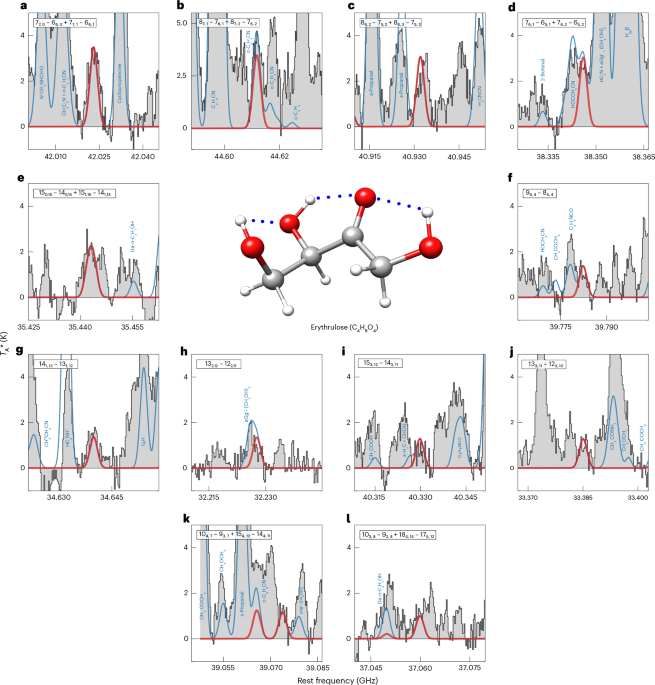
McGuire, B. A. 2021 census of interstellar, circumstellar, extragalactic, protoplanetary disk, and exoplanetary molecules. Astrophys. J. Supp. Series 259, 30 (2022).
Cernicharo, J. et al. Pure hydrocarbon cycles in TMC-1: discovery of ethynyl cyclopropenylidene, cyclopentadiene, and indene. Astron. Astrophys. 649, L15 (2021).
Wenzel, G. et al. Discovery of the seven-ring polycyclic aromatic hydrocarbon cyanocoronene (C24H11CN) in GOTHAM observations of TMC-1. Astrophys. J. Lett. 984, L36 (2025).
Fuentetaja, R. et al. Discovery of 1H-cyclopent(cd)indene (c-C11H8) in TMC-1 with the QUIJOTE line survey: a new three-ringed polycyclic aromatic hydrocarbon. Astron. Astrophys. 706, L10 (2026).
Belloche, A. et al. Re-exploring molecular complexity with ALMA (ReMoCA): interstellar detection of urea. Astron. Astrophys. 628, A10 (2019).
Jiménez-Serra, I. et al. Toward the RNA-world in the interstellar medium—detection of urea and search of 2-amino-oxazole and simple sugars. Astrobiology 20, 1048–1066 (2020).
Rivilla, V. M. et al. Prebiotic precursors of the primordial RNA world in space: detection of NH2OH. Astrophys. J. Lett. 899, L28 (2020).
Rivilla, V. M. et al. Discovery in space of ethanolamine, the simplest phospholipid head group. Proc. Natl Acad. Sci. USA 118, e2101314118 (2021).
Rivilla, V. M. et al. Precursors of the RNA world in space: detection of (Z)-1,2-ethenediol in the interstellar medium, a key intermediate in sugar formation. Astrophys. J. Lett. 929, L11 (2022).
Ruiz-Mirazo, K., Briones, C. & de la Escosura, A. Prebiotic systems chemistry: new perspectives for the origins of life. Chem. Rev. 114, 285–366 (2014).
Becker, S. et al. Unified prebiotically plausible synthesis of pyrimidine and purine rna ribonucleotides. Science 366, 76–82 (2019).
Menor Salván, C. et al. Prebiotic origin of pre-RNA building blocks in a urea “warm little pond” scenario. ChemBioChem 21, 3504–3510 (2020).
Fiore, M. et al. Synthesis of phospholipids under plausible prebiotic conditions and analogies with phospholipid biochemistry for origin of life studies. Astrobiology 22, 598–627 (2022).
Powner, M., Gerland, B. & Sutherland, J. Synthesis of activated pyrimidine ribonucleotides in prebiotically plausible conditions. Nature 459, 239–242 (2009).
Patel, B. H., Percivalle, C., Ritson, D. J., Duffy, C. D. & Sutherland, J. D. Common origins of RNA, protein and lipid precursors in a cyanosulfidic protometabolism. Nat. Chem. 7, 301–307 (2015).
Mizuno, T. & Weiss, A. H. in Advances in Carbohydrate Chemistry and Biochemistry (eds Tipson, R. S. & Horton, D.) Vol. 29, 173–227 (Academic Press, 1974).
Kopetzki, D. & Antonietti, M. Hydrothermal formose reaction. New J. Chem. 35, 1787–1794 (2011).
Delidovich, I. V., Simonov, A. N., Taran, O. P. & Parmon, V. N. Catalytic formation of monosaccharides: from the formose reaction towards selective synthesis. ChemSusChem 7, 1833–1846 (2014).
Haas, M., Lamour, S., Christ, S. B. & Trapp, O. Mineral-mediated carbohydrate synthesis by mechanical forces in a primordial geochemical setting. Commun. Chem. 3, 140 (2020).
Furukawa, Y. et al. Extraterrestrial ribose and other sugars in primitive meteorites. Proc. Natl Acad. Sci. USA 116, 24440–24445 (2019).
Furukawa, Y. et al. Bio-essential sugars in samples from asteroid Bennu. Nat. Geosci. 19, 19–24 (2026).
Hollis, J. M., Lovas, F. J. & Jewell, P. R. Interstellar glycolaldehyde: the first sugar. Astrophys. J. Lett. 540, L107–L110 (2000).
Beltrán, M. T., Codella, C., Viti, S., Neri, R. & Cesaroni, R. First detection of glycolaldehyde outside the Galactic Center. Astrophys. J. Lett. 690, L93–L96 (2009).
Jørgensen, J. K. et al. Detection of the simplest sugar, glycolaldehyde, in a solar-type protostar with alma. Astrophys. J. Lett. 757, L4 (2012).
Porterfield, J. P. et al. Pyrolysis of the simplest carbohydrate, glycolaldehyde (CHO-CH2OH), and glyoxal in a heated microreactor. J. Phys. Chem. A 120, 2161–2172 (2016).
Cocinero, E. J. et al. Ribose found in the gas phase. Angew. Chem. Int. Ed. 51, 3119–3124 (2012).
Peña, I. et al. Six pyranoside forms of free 2-deoxy-d-ribose. Angew. Chem. Int. Ed. 52, 11840–11845 (2013).
Insausti, A. et al. Laboratory observation of, astrochemical search for, and structure of elusive erythrulose in the interstellar medium. J. Phys. Chem. Lett. 12, 1352–1359 (2021).
Hollis, J. M., Jewell, P. R., Lovas, F. J. & Remijan, A. Green Bank telescope observations of interstellar glycolaldehyde: low-temperature sugar. Astrophys. J. Lett. 613, L45–L48 (2004).
Widicus Weaver, S. L. & Blake, G. A. 1,3-Dihydroxyacetone in Sagittarius B2(N-LMH): the first interstellar ketose. Astrophys. J. Lett. 624, L33–L36 (2005).
Apponi, A. J. et al. Investigating the limits of chemical complexity in Sagittarius B2(N): a rigorous attempt to confirm 1,3-dihydroxyacetone. Astrophys. J. Lett. 643, L29–L32 (2006).
GRAVITY Collaboration. A geometric distance measurement to the Galactic Center black hole with 0.3% uncertainty. Astron. Astrophys. 625, L10 (2019).
Requena-Torres, M. A. et al. Organic molecules in the Galactic Center. Hot core chemistry without hot cores. Astron. Astrophys. 455, 971–985 (2006).
Zeng, S. et al. Complex organic molecules in the Galactic Centre: the N-bearing family. Mon. Not. R. Astron. Soc. 478, 2962–2975 (2018).
Jiménez-Serra, I. et al. Precursors of fatty alcohols in the ISM: discovery of n-propanol. Astron. Astrophys. 663, A181 (2022).
Sanz-Novo, M. et al. Discovery of the elusive carbonic acid (HOCOOH) in space. Astrophys. J. 954, 3 (2023).
Zeng, S. et al. Cloud–cloud collision as drivers of the chemical complexity in Galactic Centre molecular clouds. Mon. Not. R. Astron. Soc. 497, 4896–4909 (2020).
Araki, M. et al. A detection of sulfur-bearing cyclic hydrocarbons in space. Nat. Astron. 10, 401A (2026).
Martín, S., Requena-Torres, M. A., Martín-Pintado, J. & Mauersberger, R. Tracing shocks and photodissociation in the Galactic Center region. Astrophys. J. 678, 245–254 (2008).
Rodríguez-Almeida, L. F. et al. Thiols in the interstellar medium: first detection of HC(O)SH and confirmation of C2H5SH. Astrophys. J. Lett. 912, L11 (2021).
Rodríguez-Almeida, L. F. et al. First detection of C2H5NCO in the ISM and search of other isocyanates towards the G+0.693–0.027 molecular cloud. Astron. Astrophys. 654, L1 (2021).
Sanz-Novo, M. et al. Toward the limits of complexity of interstellar chemistry: rotational spectroscopy and astronomical search for n- and i-butanal. Astron. Astrophys. 666, A114 (2022).
Snyder, L. E. et al. A rigorous attempt to verify interstellar glycine. Astrophys. J. 619, 914–930 (2005).
Halfen, D. T., Apponi, A. J., Woolf, N., Polt, R. & Ziurys, L. M. A systematic study of glycolaldehyde in Sagittarius B2(N) at 2 and 3 mm: criteria for detecting large interstellar molecules. Astrophys. J. 639, 237–245 (2006).
Colzi, L. et al. Deuterium fractionation as a multiphase component tracer in the Galactic Center. Astrophys. J. Lett. 926, L22 (2022).
Zhang, C. et al. Ionizing radiation exposure on Arrokoth shapes a sugar world. Proc. Natl Acad. Sci. USA 121, e2320215121 (2024).
Joshi, P. R. & Lee, Y.-P. Identification of HOC•HC(O)H, HOCH2C•O, and HOCH2CH2O• intermediates in the reaction of H + glycolaldehyde in solid para-hydrogen and its implication to the interstellar formation of complex sugars. J. Am. Chem. Soc. 146, 23306–23320 (2024).
Wang, J., Marks, J. H., Fortenberry, R. C. & Kaiser, R. I. Interstellar formation of glyceric acid (HOCH2CH(OH)COOH)—the simplest sugar acid. Sci. Adv. 10, eadl3236 (2024).
Rodríguez-Fernández, N. J., Martín-Pintado, J., Fuente, A. & Wilson, T. L. ISO observations of the Galactic Center interstellar medium. Neutral gas and dust. Astron. Astrophys. 427, 217–229 (2004).
Etxaluze, M. et al. Herschel observations of the Sagittarius B2 cores: hydrides, warm CO, and cold dust. Astron. Astrophys. 556, A137 (2013).
Cuppen, H. & Herbst, E. Simulation of the formation and morphology of ice mantles on interstellar grains. Astrophys. J. 668, 294–309 (2007).
Cuppen, H., van Dishoeck, E. F., Herbst, E. & Tielens, A. Microscopic simulation of methanol and formaldehyde ice formation in cold dense cores. Astron. Astrophys. 508, 275–287 (2009).
Lamberts, T., de Vries, X. & Cuppen, H. The formation of ice mantles on interstellar grains revisited—the effect of exothermicity. Faraday Discuss. 168, 327–347 (2014).
Simons, M. A. J., Lamberts, T. & Cuppen, H. M. Formation of COMs through CO hydrogenation on interstellar grains. Astron. Astrophys. 634, A52 (2020).
Goto, M. et al. Infrared H3+ and CO studies of the galactic core: GCIRS 3 and GCIRS 1W. Astrophys. J. 786, 96 (2014).
Le Petit, F. et al. Physical conditions in the central molecular zone inferred by \({{\rm{H}}}_{3}^{+}\). Astron. Astrophys. 585, A105 (2016).
Martín-Pintado, J., de Vicente, P., Fuente, A. & Planesas, P. SiO emission from the Galactic Center molecular clouds. Astrophys. J. Lett. 482, L45–L48 (1997).
Jiménez-Serra, I., Caselli, P., Martín-Pintado, J. & Hartquist, T. W. Parametrization of C-shocks. Evolution of the sputtering of grains. Astron. Astrophys. 482, 549–559 (2008).
Rivilla, V. M. et al. Ionize hard: interstellar PO+ detection. Front. Astron. Space Sci. 9, 829288 (2022).
Sanz-Novo, M. et al. Interstellar detection of O-protonated carbonyl sulfide, HOCS+. Astrophys. J. 965, 149 (2024).
Ginsburg, A. et al. JWST reveals widespread CO ice and gas absorption in the Galactic Center cloud G0.253+0.016. Astrophys. J. 959, 36 (2023).
Lema-Saavedra, A., Fernández-Ramos, A. & Martínez-Núñez, E. Computational insights into the chemical reaction networks of C3H6O3, C3H7O3 and C2H5O2: implications for the interstellar medium. Phys. Chem. Chem. Phys. 27, 22424–22433 (2025).
Fernández-Ruz, M., Jiménez-Serra, I. & Aguirre, J. A theoretical approach to the complex chemical evolution of phosphorus in the interstellar medium. Astrophys. J. 956, 47 (2023).
Fried, Z. T. P. et al. Rotational spectrum and first interstellar detection of 2-methoxyethanol using ALMA observations of NGC 6334I. Astrophys. J. Lett. 965, L23 (2024).
McGuire, B. A. et al. Discovery of the interstellar chiral molecule propylene oxide (CH3CHCH2O). Science 352, 1449–1452 (2016).
Islam, S., Bučar, D.-K. & Powner, M. W. Prebiotic selection and assembly of proteinogenic amino acids and natural nucleotides from complex mixtures. Nat. Chem. 9, 584–589 (2017).
Nagorski, R. W. & Richard, J. P. Mechanistic imperatives for aldose–ketose isomerization in water: specific, general base- and metal ion-catalyzed isomerization of glyceraldehyde with proton and hydride transfer. J. Am. Chem. Soc. 123, 794–802 (2001).
Colville, B. W. F. & Powner, M. W. Selective prebiotic synthesis of α-threofuranosyl cytidine by photochemical anomerization. Angew. Chem. Int. Ed. 60, 10526–10530 (2021).
Altwegg, K., Balsiger, H. & Fuselier, S. A. Cometary chemistry and the origin of icy Solar System bodies: the view after Rosetta. Annual Rev. Astron. Astrophys. 57, 113–155 (2019).
Ligterink, N. F. W. et al. The rapid formation of macromolecules in irradiated ice of protoplanetary disk dust traps. Nat. Astron. 8, 1257–1263 (2024).
Cronin, J. R. & Pizzarello, S. Enantiomeric excesses in meteoritic amino acids. Science 275, 951–955 (1997).
Cooper, G. & Rios, A. C. Enantiomer excesses of rare and common sugar derivatives in carbonaceous meteorites. Proc. Natl Acad. Sci. USA 113, E3322–E3331 (2016).
Ribó, J. M. & Hochberg, D. Chemical basis of biological homochirality during the abiotic evolution stages on Earth. Symmetry 11, 814 (2019).
Whittet, D. C. B. & Duley, W. W. Carbon monoxide frosts in the interstellar medium. Astron. Astrophys. Rev. 2, 167–189 (1991).
Piani, L. et al. Earth’s water may have been inherited from material similar to enstatite chondrite meteorites. Science 369, 1110–1113 (2020).
Chyba, C. & Sagan, C. Endogenous production, exogenous delivery and impact-shock synthesis of organic molecules: an inventory for the origins of life. Nature 355, 125–132 (1992).
Koeberl, C. Impact processes on the early Earth. Elements 2, 211–216 (2006).
Cartwright, J., Hodges, K. & Wadhwa, M. Evidence against a late heavy bombardment event on vesta. Earth Planet. Sci. Lett. 590, 117576 (2022).
Wogan, N. F., Catling, D. C. & Zahnle, K. J. Timing and likelihood of the origin of life derived from post-impact highly reducing atmospheres. Astrobiology 24, 881–891 (2024).
McCaffrey, V. P., Zellner, N. E. B., Waun, C. M., Bennett, E. R. & Earl, E. K. Reactivity and survivability of glycolaldehyde in simulated meteorite impact experiments. Origins Life Evol. Biosphere 44, 29–42 (2014).
Zellner, N. E., McCaffrey, V. P. & Butler, J. H. Cometary glycolaldehyde as a source of pre-rna molecules. Astrobiology 20, 1377–1388 (2020).
Yu, H., Zhang, S. & Chaput, J. Darwinian evolution of an alternative genetic system provides support for TNA as an RNA progenitor. Nat. Chem. 4, 183–187 (2012).
Tercero, F. et al. Yebes 40 m radio telescope and the broad band Nanocosmos receivers at 7 mm and 3 mm for line surveys. Astron. Astrophys. 645, A37 (2021).
Megías, A. et al. The complex organic molecular content in the L1517B starless core. Mon. Not. R. Astron. Soc. 519, 1601–1617 (2023).
Martín, S. et al. Spectral Line Identification and Modelling (SLIM) in the MAdrid Data CUBe Analysis (MADCUBA) package. Interactive software for data cube analysis. Astron. Astrophys. 631, A159 (2019).
Lattanzi, V. et al. Advancing spectroscopic understanding of HOCS+: laboratory investigations and astronomical implications. Astron. Astrophys. 689, A260 (2024).
Rey-Montejo, M. et al. Discovery of MgS and NaS in the interstellar medium and tentative detection of CaO. Astrophys. J. 975, 174 (2024).
Massalkhi, S. et al. The first detection of SiC2 in the interstellar medium. Astron. Astrophys. 678, A45 (2023).
Li, J. et al. Widespread presence of glycolaldehyde and ethylene glycol around Sagittarius B2. Astrophys. J. 849, 115 (2017).
Frisch, M. J. et al. Gaussian 16 Revision A.03 (Gaussian, 2016).
Zhao, Y. & Truhlar, D. G. Design of density functionals that are broadly accurate for thermochemistry, thermochemical kinetics, and nonbonded interactions. J. Phys. Chem. A 109, 5656–5667 (2005).
Stewart, J. J. P. Optimization of parameters for semiempirical methods VI: more modifications to the NDDO approximations and re-optimization of parameters. J. Mol. Model. 19, 1–32 (2013).
Rappe, A. K., Casewit, C. J., Colwell, K. S., Goddard, W. A. I. & Skiff, W. M. UFF, a full periodic table force field for molecular mechanics and molecular dynamics simulations. J. Am. Chem. Soc. 114, 10024–10035 (1992).
Weigend, F. & Ahlrichs, R. Balanced basis sets of split valence, triple zeta valence and quadruple zeta valence quality for H to Rn: design and assessment of accuracy. Phys. Chem. Chem. Phys. 7, 3297–3305 (2005).
Roos, B. O., Taylor, P. R. & Sigbahn, P. E. A complete active space SCF method (CASSCF) using a density matrix formulated super-CI approach. Chem. Phys. 48, 157–173 (1980).
Neese, F., Wennmohs, F., Becker, U. & Riplinger, C. The ORCA quantum chemistry program package. JChPh 152, 224108 (2020).
Ferro-Costas, D., Truhlar, D. G. & Fernández-Ramos, A. Pilgrim-version 2020.2 (University of Minneapolis, Universidade de Santiago de Compostela, 2020).
Eckart, C. The penetration of a potential barrier by electrons. PhRv 35, 1303 (1930).
Marcus, R. A. Chemical and electrochemical electron-transfer theory. Annu. Rev. Phys. Chem. 15, 155–196 (1964).
Marcus, R. & Sutin, N. Electron transfers in chemistry and biology. Biochim. Biophys. Acta Rev. Bioenerg. 811, 265–322 (1985).
Ioppolo, S. et al. A non-energetic mechanism for glycine formation in the interstellar medium. Nat. Astron. 5, 197–205 (2021).
Álvarez-Barcia, S., Russ, P., Kästner, J. & Lamberts, T. Hydrogen transfer reactions of interstellar complex organic molecules. Mon. Not. R. Astron. Soc. 479, 2007 (2018).
Holdship, J., Viti, S., Jiménez-Serra, I., Makrymallis, A. & Priestley, F. UCLCHEM: a gas-grain chemical code for clouds, cores, and C-shocks. Astron. J. 154, 38 (2017).
Jiménez-Serra, I. et al. Detection of a four-carbon sugar in interstellar space. Zenodo https://doi.org/10.5281/zenodo.20081358 (2026).